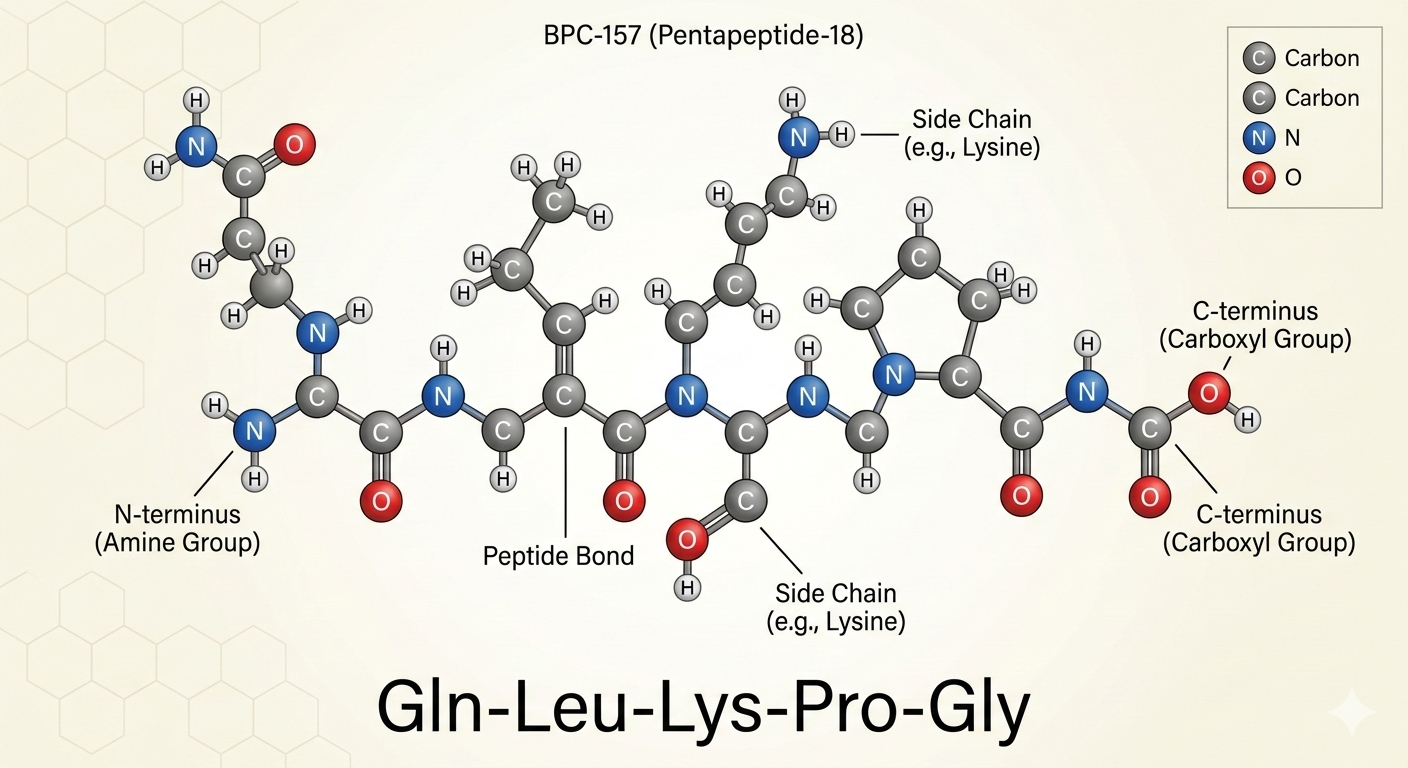
BPC-157 has become a whispered shortcut in recovery and longevity circles. The preclinical research is intriguing, but the human evidence is thin — three pilot studies, no RCTs, and a cautionary regulatory picture. Here is the clean version.
In corners of the internet where recovery, longevity, and self-experimentation overlap, BPC-157 has become a kind of whispered shortcut. The claims are familiar: faster tendon healing, calmer joints, less downtime, fewer nagging injuries that keep returning like weather over the same hill. The problem is that BPC-157 is one of those compounds where the legend has grown faster than the literature. If you want the clean version, here it is: there is real scientific interest, there are intriguing animal studies, and there is still very little human evidence.
Update, November 2026: what changed, and what didn’t
In late October 2026, HHS said FDA will use enforcement discretion toward licensed compounding pharmacies that make six peptides: BPC-157, TB-500, KPV, MOTS-c, Semax and Epitalon. In practice, FDA will not take legal action against them for doing so.[10] This is not an approval. None of the six is FDA-approved, and none is on FDA’s bulk drug substances list yet. Adding them requires a proposed rule, public comment and a final rule.[10]
The notice does add two requirements: compounders must certify the identity and purity of what they make, and they must report side effects.[10] It changes nothing about the evidence below. FDA’s own scientists concluded there was insufficient data to show these peptides are safe and effective. The advisory committee that recommended wider access split 8–6 in July 2026.[10][11]
BPC-157 is still on WADA’s Prohibited List.[8]
BPC-157 is a synthetic pentadecapeptide, meaning it is a short chain of 15 amino acids. It is linked to earlier research on compounds derived from gastric juice and has been studied for possible cytoprotective and wound-healing effects. In plain English, researchers have been asking whether it can help injured tissue recover — especially in places that heal slowly and stubbornly, such as tendons, ligaments, muscle, and parts of the gastrointestinal tract.
What the Preclinical Research Actually Shows
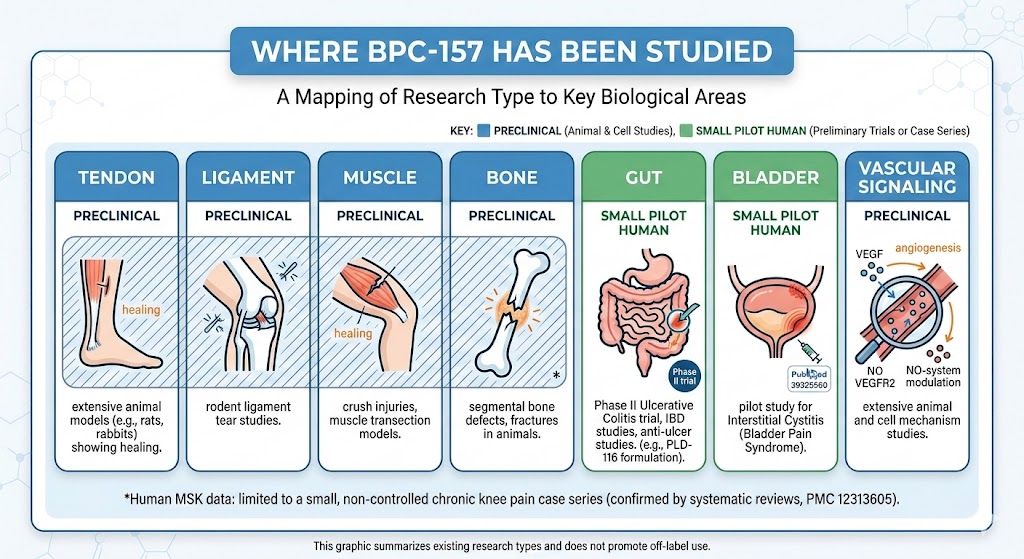
That interest did not come from nowhere. Preclinical research has repeatedly reported encouraging findings in animals. A 2025 systematic review of the musculoskeletal literature found 36 relevant studies published from 1993 through 2024.[1] Thirty-five were preclinical. One was clinical. Across those animal studies, BPC-157 was associated with improved structural, functional, and biomechanical healing outcomes in muscle, tendon, ligament, and bone injury models. In tendon-focused work, researchers found increased fibroblast migration and survival under stress,[2] which helps explain why BPC-157 is so often discussed in the language of repair.
It has the shape of a recovery tool in the lab. The question is whether that shape survives contact with human reality.
The Human Evidence: Small and Sparse
That is where the floor starts to drop away. The human evidence is tiny. The most cited musculoskeletal study is a retrospective review from a private clinic in Florida.[3] Sixteen patients were reached for follow-up. Of the 12 who received BPC-157 alone as an intra-articular knee injection, 11 reported significant improvement. The broader group, including a few patients who received BPC-157 with TB4, also reported improvement. Still, it was a small retrospective study, with no control group, varied diagnoses, and no standardized functional outcome framework. It is the kind of study that can justify more research. It is not the kind of study that settles anything.
Outside sports medicine, the published human record remains just as small. A 2024 pilot study in interstitial cystitis reported improvement in 12 women after intravesical BPC-157 injection.[4] A 2025 pilot safety study reported no measurable adverse effects in 2 adults after intravenous infusion.[5] Even the more favorable recent review from outside the original BPC-157 research orbit summarized the situation plainly:[6] only three pilot studies have examined BPC-157 in humans, and rigorous large-scale trials are still lacking.
This is a candle, not a floodlight. Three pilot studies. No randomized controlled trials in musculoskeletal medicine. The conversation around BPC-157 often sounds much more certain than the evidence allows.
The Replication Problem
That thinness matters because the conversation around BPC-157 often sounds much more certain than the evidence allows. Recent reviewers and investigative reporting have noted that human data are extremely limited and that a substantial share of the broader literature comes from a relatively small cluster of researchers,[1] making independent replication unusually important here. Science does not become false because one group publishes a lot of it, but it does become more fragile. When many roads run through the same village, you want to know whether the map still works once you leave it.
Who Might Be Interested — and Why
So who is BPC-157 potentially useful for, at least in theory? The people most likely to be drawn to it are easy to picture: athletes nursing tendon pain, lifters with overuse injuries that never quite cool off, runners who feel one hamstring strain away from another lost season, or patients with chronic irritation who feel conventional options have plateaued. The research logic behind that interest is not absurd. In fact, it is strong enough that a randomized, double-blind, placebo-controlled Phase 2 study for acute grade II hamstring strain is now registered.[7] That is a sign of legitimate scientific curiosity. It is also a reminder that we are still waiting for the kind of trial that tells us whether excitement should harden into confidence.
Who Should Be Cautious
Competitive athletes are first in line, because BPC-157 has been on WADA’s Prohibited List since 2022 under S0 Non-Approved Substances and remains there in 2026.[8] People who assume a peptide sold through a clinic or wellness channel must therefore be well-characterized and medically settled should also slow down. In 2023, FDA flagged compounded BPC-157 as a substance that may present significant safety risks, citing immunogenicity concerns, peptide-related impurities, and insufficient safety information for proposed routes of administration.[9] The October 2026 HHS notice means FDA will no longer act against licensed compounders who make it, but the agency’s own scientists had concluded that the safety and efficacy data are insufficient.[10] That is not bureaucratic nitpicking. It is a reminder that a gray-market recovery story can hide a manufacturing problem inside the bottle.
Regulatory note: BPC-157 is on WADA’s Prohibited List (S0, since 2022). Since October 2026, FDA has used enforcement discretion toward licensed compounders who make it, but it is not FDA-approved, and FDA scientists found the safety and efficacy data insufficient. This article is informational and does not constitute medical advice or endorsement of off-label use.
There is another reason to be careful. BPC-157 is often discussed through mechanisms related to angiogenesis and tissue repair. Those are exactly the kinds of pathways that make a compound sound exciting in recovery circles, and exactly the kinds of pathways that deserve caution when long-term human safety is unclear. Recent review authors have raised theoretical concerns about pathologic angiogenesis and other unresolved safety questions,[6] while also acknowledging that the present human data are too thin to answer them. That does not prove danger. It proves uncertainty. And uncertainty is what honest writing should preserve when certainty has not been earned.
If You’re Going to Track It, Track It Right
If someone is going to think about BPC-157 anyway, the least useful approach is the one most common online: take a dozen things at once, change training, change diet, sleep differently, then announce a verdict from memory two weeks later. That is not experimentation. That is storytelling.
A more defensible personal framework would be narrow and boring in the best way:
- Pick one target outcome. Not “feel better,” but a specific pain score, range of motion, or training metric.
- Keep other recovery variables as stable as possible. Sleep, nutrition, training load, other supplements.
- Track pain, function, training load, sleep, re-aggravation, and adverse effects on a defined timeline.
- If labs or imaging matter to the condition, include those too.
The point is not to turn yourself into a clinical trial. The point is to avoid lying to yourself with noisy data.

This is exactly where a tool like Micros can be more useful than another opinion thread. With a compound like BPC-157, the interesting question is rarely “Did I take it?” The useful question is “What changed, when, relative to what else?” A timestamped record of symptoms, training volume, recovery markers, biomarker uploads, and qualitative notes gives you something anecdotes never can: sequence. If pain improved, did it improve after reduced volume, improved sleep, and better rehab compliance — or after the intervention itself? If symptoms rebounded, was that after returning to intensity?
When the research base is thin, chronology becomes a form of honesty. It keeps the story from editing itself.
The Bottom Line
BPC-157 may eventually prove to be more than hype. The preclinical work is strong enough to justify continued investigation, and the emergence of better-designed trials is a healthy sign. But as of November 2026, the cleanest reading is still this one:
- Investigational — not proven, not disproven
- Human evidence is sparse — three pilot studies, no RCTs in MSK
- Regulatory picture is mixed — WADA-banned, and compounding is now tolerated but not approved
- Confidence should wait for better trials
Curiosity is fair. Belief should wait for better trials.
References
- Vasireddi A, et al. Emerging Use of BPC-157 in Orthopaedic Sports Medicine: A Systematic Review. Orthop J Sports Med. 2025.
- Chang C-H, et al. The promoting effect of pentadecapeptide BPC 157 on tendon healing involves tendon outgrowth, cell survival, and cell migration. J Appl Physiol. 2011;110(3):774–780.
- Lee E, et al. Intra-Articular Injection of BPC 157 for Multiple Types of Knee Pain. Altern Ther Health Med. 2021.
- Lee E, et al. Effect of BPC-157 on Symptoms in Patients with Interstitial Cystitis. Curr Urol. 2024.
- Lee E, et al. Safety of Intravenous Infusion of BPC157 in Humans. 2025.
- McGuire A, et al. Regeneration or Risk? A Narrative Review of BPC-157 for Musculoskeletal Healing. 2025.
- ClinicalTrials registry. BPC-157 for Acute Hamstring Muscle Strain Repair — Phase 2 RCT.
- WADA. 2022 Prohibited List update and current 2026 Prohibited List resources.
- FDA. Certain Bulk Drug Substances for Use in Compounding that May Present Significant Safety Risks.
- NBC News. RFK Jr. takes shortcut to make some unapproved peptides available for use. 28 October 2026.
- Fortune. RFK Jr.’s HHS is letting pharmacies sell 6 unproven peptides like the ‘Wolverine stack’ — and no regulator will check what’s in them. 13 November 2026.