
In SELECT, semaglutide cut heart events by 20% and lowered hsCRP even in people who lost little weight. Studies of plaque itself disagree. A study-by-study look at the 2025 to 2026 evidence on GLP-1 drugs and atherosclerosis.
In the SELECT trial, some people took semaglutide for two years and lost less than 2% of their body weight. Their hsCRP still went down by 12%. In the placebo group, people with the same small weight change had a 2% increase in hsCRP.[1]
hsCRP (high-sensitivity C-reactive protein) is a blood marker of inflammation. Higher levels predict more heart attacks and strokes. That small subgroup is part of the answer to a question that many GLP-1 users ask. Does the drug protect the heart only because you lose weight?
Information only: This article is not medical advice. Speak with your clinician before you change a medication.
Fewer heart attacks: the strongest evidence
The SELECT results were published on 11 November 2023 in the New England Journal of Medicine.[2] The trial enrolled 17,604 adults with established cardiovascular disease and overweight or obesity. None had diabetes. Each person received semaglutide 2.4 mg weekly or a placebo, on top of their usual care. Mean follow-up was 39.8 months, about 3.3 years.
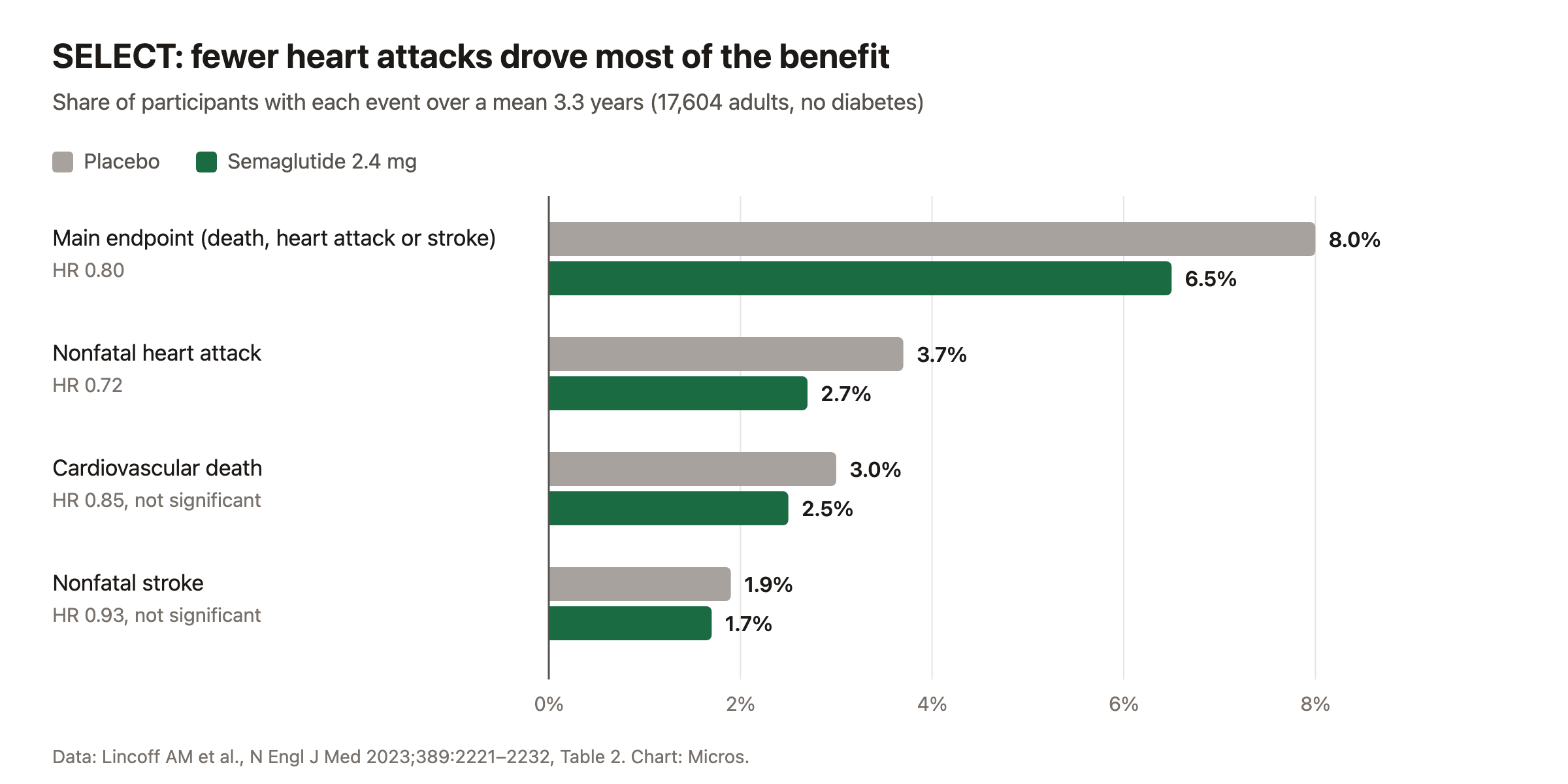
The main endpoint combined cardiovascular death, nonfatal heart attack, and nonfatal stroke. It occurred in 6.5% of the semaglutide group and 8.0% of the placebo group. That is a 20% lower relative risk (hazard ratio 0.80, 95% CI 0.72 to 0.90).
Fewer nonfatal heart attacks caused most of that difference: 2.7% against 3.7%. The difference in cardiovascular death (2.5% against 3.0%) did not reach statistical significance. Stroke rates were almost the same. In absolute terms, the trial prevented about one event for every 67 people treated for 3.3 years. That figure is our calculation from the raw rates; the paper does not report it. More people stopped semaglutide because of side effects: 16.6%, against 8.2% on placebo.
How much comes from weight loss? No one has a reliable number
The SELECT team published a prespecified analysis of body size in The Lancet on 22 October 2025.[3] The benefit was similar at every starting weight and waist size. Weight lost by week 20 did not predict later protection in a linear way. The team estimated that a smaller waist explained about 33% of the benefit. The authors described the benefit as “independent of baseline adiposity and weight loss.”
One result in that paper is unexpected. In the placebo group, people who lost weight had more cardiovascular events, not fewer. Weight loss without a drug can be a sign of illness, and that is one possible cause. The analysis cannot confirm it.
On 23 September 2026, the same research group published a second mediation analysis in the European Heart Journal.[4] It used a different method and tested eight possible routes for the benefit, one at a time.
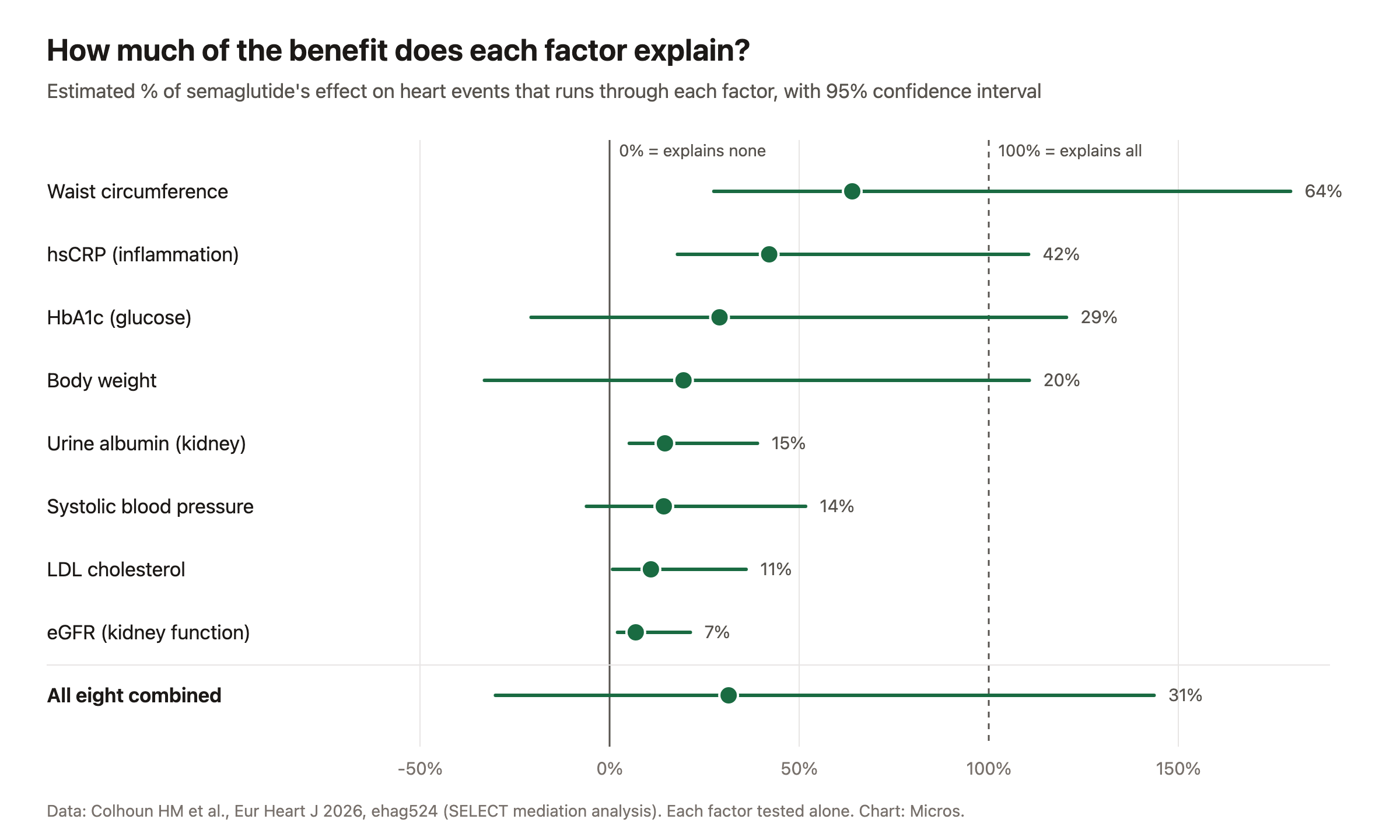
With this method, waist explained 64% of the benefit, not 33%. The confidence interval ran from 27.5% to 179.6%. Body weight explained 19.5%, with an interval from minus 33% to 111%. When the team combined all eight factors, the estimate was 31.4%, with an interval from minus 30% to 144%. An interval that crosses zero and passes 100% tells you very little. The authors wrote that they could not assign the benefit to known risk factors “with any certainty.”
So the data argue against the idea that weight loss is the full explanation. They do not tell you what share is a direct effect of the drug.
Novo Nordisk, the maker of semaglutide, funded SELECT and the analyses above. Several authors are company employees. The papers went through peer review, but you should know the source of the funds.
Inflammation: lower at every level of weight loss
The hsCRP analysis was published online in Circulation on 18 August 2026.[1] At 104 weeks, semaglutide lowered hsCRP by 37.8% compared with placebo (95% CI 35.9% to 39.7%).
The decrease started early. In a subgroup of 6,011 European participants, hsCRP was 12% lower than baseline at week 4 and 19% lower at week 8. Weight loss at those points was only 1.4% and 2.8%. In the placebo group, hsCRP barely changed in that period. These early numbers compare each person with their own baseline, not with placebo.
The clearest test is to compare people who lost the same amount of weight.
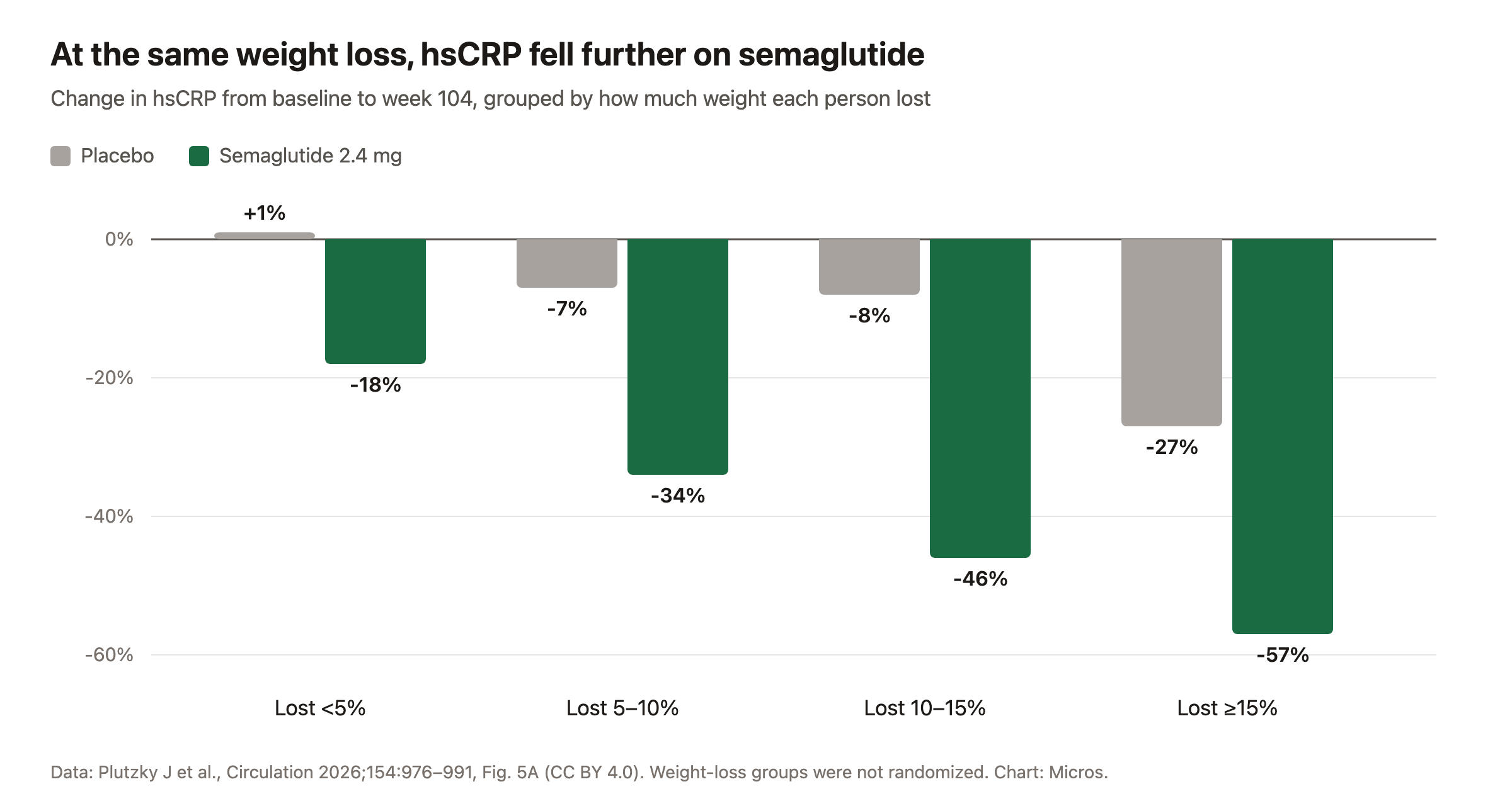
In both groups, more weight loss went with a larger decrease in hsCRP. But in each weight-loss band, the semaglutide group had a larger decrease than the placebo group. Among people who lost 15% or more, hsCRP fell 27% on placebo and 57% on semaglutide.
These subgroups were not randomized. People who lose a lot of weight on placebo can be different from people who lose a lot on semaglutide. When the team adjusted the main result for the change in hsCRP, the hazard ratio moved from 0.80 to 0.86. The authors interpret this to mean that lower inflammation may explain part of the benefit. That is an association. It also does not show where the drug acts. The effect could be in the artery wall, the liver, fat tissue, or immune cells.
Plaque: the results do not agree
For many readers, this is the important question. Does a GLP-1 drug shrink or calm plaque that is already in your arteries? Six human studies have measured plaque or a related marker.
| Study | Who and design | Imaging | Result |
|---|---|---|---|
| Liu et al., Radiol Med, July 2026[5] | 880 serial CT scans in people with type 2 diabetes; 88 in the GLP-1 group. Registry, not randomized. | Coronary CT angiography | Less progression of narrowing with GLP-1 drugs (HR 0.68, 95% CI 0.49–0.95). Measured narrowing scores, not plaque volume. |
| Gitto et al., Acta Diabetol, Nov 2025[6] | 28 people with diabetes after an acute coronary syndrome (17 heart attacks, 11 unstable angina); 7 on GLP-1 drugs. Registry, 1 year. | Coronary CT angiography | Percent atheroma volume decreased 6.1% with GLP-1 drugs and 0.7% without. |
| Kataoka et al. (OPTIMAL), Atheroscler Plus, 2024[7] | 78 people with diabetes and coronary disease, all on statins; 16 on GLP-1 drugs. GLP-1 use was not randomized. 48 weeks. | Intravascular ultrasound + NIRS | No difference in plaque volume. The lipid-rich part decreased in 85.6% of GLP-1 users and 42.0% of others. |
| Koska et al., Diabetes Care, 2021[8] | Randomized trial, 163 people with type 2 diabetes. Exenatide or placebo for 18 months. | Carotid MRI | No difference in plaque volume or composition. |
| James et al., Am Heart J, 2025[9] | Randomized trial, 101 people with type 2 diabetes and cardiovascular disease. Semaglutide 1.0 mg or placebo for 26 weeks. | Carotid PET-MRI | No change in the arterial inflammation signal. The authors note that baseline inflammation was low. |
| Sandsdal et al., Nat Metab, June 2026[10] | Randomized trial, 130 adults with obesity and no diabetes, after diet-induced weight loss. 52 weeks. | Carotid ultrasound (wall thickness) | Wall thickness decreased 7% with exercise and 6% with exercise plus liraglutide. No change with liraglutide alone. |
The positive results come from small studies or registries, where doctors chose who got the drug. The randomized trials found no clear change. The Nature Metabolism trial is the most direct test of the “beyond weight” idea. The liraglutide group kept the weight off, but its carotid wall thickness did not change. The exercise groups had a decrease. Carotid wall thickness is not the same as plaque volume, so this result does not settle the question.
Plaque contains a lipid core, immune cells, fibrous tissue, and calcium. A drug can make plaque less likely to rupture without a decrease in its size. Two results fit that idea. In OPTIMAL, total plaque volume did not change, but the lipid-rich part decreased in more GLP-1 users. In the STOP trial of semaglutide, the main plaque result was negative.[11] An exploratory analysis showed a shift from soft plaque to calcified plaque. STOP was presented at the American Heart Association meeting in November 2022 and is not yet published in a journal. This “stabilization” idea is a hypothesis.
A rabbit study that removes weight and glucose from the equation
A team at Massachusetts General Hospital published this study in the European Heart Journal on 2 April 2026.[12] They gave liraglutide or saline for four weeks to 28 rabbits with established atherosclerosis. The rabbits were not obese, and their blood glucose was normal.
On intravascular ultrasound, the change in percent atheroma volume was 7.8 points lower with liraglutide than with saline (95% CI 4.2 to 11.3). Plaques had fewer macrophages and less activity of cathepsin, an enzyme that breaks down tissue. Blood CRP was lower. Because the rabbits had no obesity and no diabetes, the result cannot come from treatment of either condition.
The same paper looked at 47,324 people in the Mass General Brigham Biobank. A GLP-1 prescription was associated with lower inflammatory markers and fewer cardiovascular events, in all BMI and HbA1c groups. That part is observational.
Reviews list several possible mechanisms: less macrophage inflammation, better function of the artery lining, less oxidative stress, and changes in smooth muscle cells. A 2026 review notes that most of this evidence comes from animal and cell studies.[13]
How this compares with LDL-lowering drugs
Randomized trials have measured plaque regression with LDL-lowering drugs. In GLAGOV (2016), 968 patients on a statin received evolocumab or placebo for 76 weeks.[14] Percent atheroma volume decreased by 0.95 points with evolocumab and increased by 0.05 points with placebo. In PACMAN-AMI (2022), 300 patients received alirocumab or placebo after a heart attack.[15] Percent atheroma volume decreased by 2.13 points with alirocumab and by 0.92 points with placebo.
No GLP-1 drug has a positive randomized trial with plaque volume as the main endpoint. For a person with known coronary plaque, LDL and ApoB lowering is the established method. A GLP-1 drug is a possible addition to it. The evidence does not support it as a replacement.
What you can measure
If you take a GLP-1 drug, two lab values tell you about the two parts of this story. ApoB (or LDL) shows the cholesterol load that builds plaque. hsCRP shows inflammation. Measure both before you start, if you can, and again after a few months. An infection or a hard training session can raise hsCRP for some days, so do the test when you are well.
In Micros, add semaglutide or tirzepatide to your stack with its start date, and upload your lab reports. Micros reads the values from each report, including hsCRP and ApoB, and charts each marker over time. You can then compare the trend with your start date. This does not tell you if your plaque changed. It tells you if your inflammation and cholesterol markers moved, and when.
The trial that has not been done
No trial has tested whether a GLP-1 drug stabilizes or shrinks coronary plaque in a lean person with normal blood glucose. Many longevity-focused readers fit that description.
The nearest trial is IDEAL-COR (NCT06606821). It gives tirzepatide or placebo to 124 people with a BMI of 27 or more and no diabetes. It measures the lipid-rich part of coronary plaque with NIRS-IVUS at 52 weeks. Its expected primary completion date is March 2027. A mazdutide trial (NCT07657676) started in September 2026 and uses CT angiography. An oral semaglutide trial in people with prediabetes (NCT07254572) is expected to finish in 2029. All three enroll people with overweight or abnormal glucose.
References
- Plutzky J, Bogdański P, Colhoun HM, et al. Effect of Semaglutide on the Inflammatory Biomarker High-Sensitivity CRP in Patients With Established Cardiovascular Disease and Overweight or Obesity in SELECT: A Prespecified Secondary Analysis. Circulation. 2026;154(11):976–991.
- Lincoff AM, Brown-Frandsen K, Colhoun HM, et al. Semaglutide and Cardiovascular Outcomes in Obesity without Diabetes. N Engl J Med. 2023;389(24):2221–2232.
- Deanfield J, Lincoff AM, Kahn SE, et al. Semaglutide and cardiovascular outcomes by baseline and changes in adiposity measurements: a prespecified analysis of the SELECT trial. Lancet. 2025;406(10516):2257–2268.
- Colhoun HM, Lincoff AM, Ryan D, et al. Semaglutide and cardiovascular risk reduction: a mediation analysis of the SELECT trial. Eur Heart J. 2026; ehag524.
- Liu R, Zhang J, Chen Z, et al. Comparison of non-insulin glucose-lowering therapies on coronary atherosclerotic plaque progression in diabetes. Radiol Med. 2026;131(9):1523–1534.
- Gitto M, Catapano F, Francone M, et al. GLP-1 receptor agonists and coronary plaques regression in diabetic patients after acute coronary syndromes. Acta Diabetol. 2026;63(2):179–191.
- Kataoka Y, Kitahara S, Funabashi S, et al. Glucagon-like Peptide-1 analogues and delipidation of coronary atheroma in statin-treated type 2 diabetic patients with coronary artery disease: The prespecified sub-analysis of the OPTIMAL randomized clinical trial. Atheroscler Plus. 2024;56:1–6.
- Koska J, Migrino RQ, Chan KC, Cooper-Cox K, Reaven PD. The Effect of Exenatide Once Weekly on Carotid Atherosclerosis in Individuals With Type 2 Diabetes: An 18-Month Randomized Placebo-Controlled Study. Diabetes Care. 2021;44(6):1385–1392.
- James S, Christoffersen AD, David JP, et al. Effect of once-weekly subcutaneous semaglutide on arterial inflammation in people with type 2 diabetes and cardiovascular disease using PET-MRI: Primary results of a randomized, double-blind, placebo-controlled trial. Am Heart J. 2025;289:17–27.
- Sandsdal RM, Holt J, Alkhefagie HGA, et al. Effects of exercise and liraglutide on vascular health and inflammation during weight loss maintenance: a prespecified secondary analysis of the S-LiTE trial. Nat Metab. 2026;8(7):1483–1488.
- ClinicalTrials.gov. Semaglutide Treatment On Coronary Progression (STOP), NCT03985384. Results presented at the American Heart Association Scientific Sessions, November 2022.
- Kassab MB, Khraishah H, Thrapp A, et al. Glucagon-like peptide-1 receptor agonists reduce experimental atherosclerosis progression, inflammatory biomarkers and cardiovascular events, irrespective of hyperglycaemia and obesity. Eur Heart J. 2026;47(28):3800–3817.
- Zawadzki M, Karczewska-Kupczewska M. Direct or Indirect Action? Mechanisms of the Antiatherosclerotic Effects of Glucagon-Like Peptide-1 Receptor Agonists. Cardiovasc Ther. 2026:e8388511.
- Nicholls SJ, Puri R, Anderson T, et al. Effect of Evolocumab on Progression of Coronary Disease in Statin-Treated Patients: The GLAGOV Randomized Clinical Trial. JAMA. 2016;316(22):2373–2384.
- Räber L, Ueki Y, Otsuka T, et al. Effect of Alirocumab Added to High-Intensity Statin Therapy on Coronary Atherosclerosis in Patients With Acute Myocardial Infarction: The PACMAN-AMI Randomized Clinical Trial. JAMA. 2022;327(18):1771–1781.