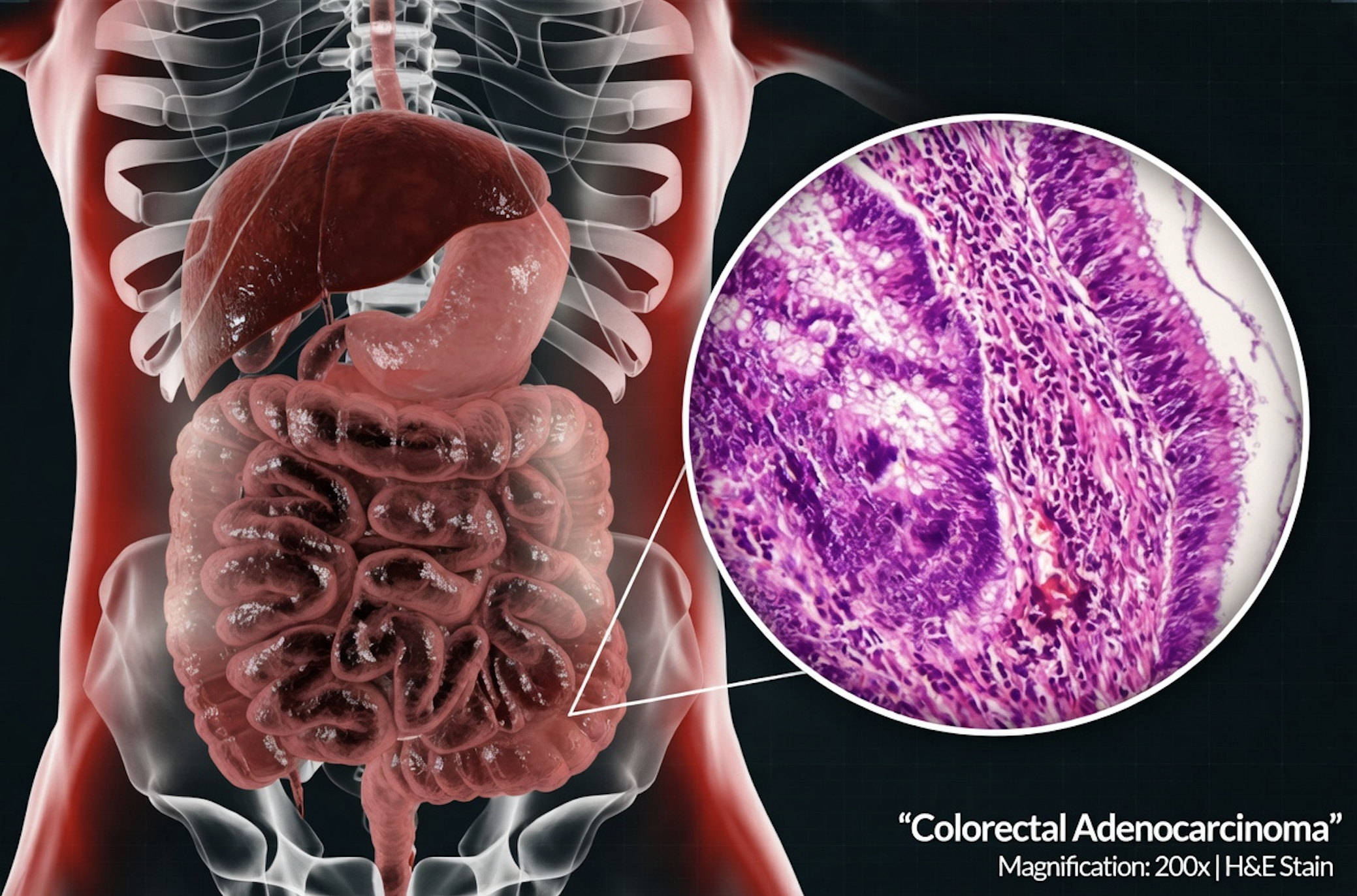
This is the molecular plausibility behind the fiber-cancer association, and it is why the soluble/insoluble/RS framework matters: different fibers feed different bacteria, producing different fermentation outputs.
Colorectal cancer ct scan - courtesy ScienceDirect
Colorectal cancer incidence in adults under 50 has increased by approximately 2.4% per year since the mid-1990s, according to the American Cancer Society's 2023 surveillance data. The trend was significant enough that the U.S. Preventive Services Task Force lowered the recommended screening age from 50 to 45 in 2021. The causal picture is multifactorial: ultra-processed food exposure, sedentary behavior, antibiotic overuse, but one signal appears consistently across the epidemiological literature: low dietary fiber intake is associated with elevated colorectal cancer risk in a dose-dependent pattern.
A 2011 meta-analysis in the BMJ (Aune et al.) found that each 10g/day increase in total dietary fiber was associated with approximately a 10% reduction in colorectal cancer risk. To be clear about what that means mechanistically: fiber intake is one associative variable among many, not a singular prevention strategy. But the signal is consistent, the plausible mechanisms are well-characterized, and the average Western diet sits at 10–15g per day — roughly one-third of the threshold where meaningful microbiome benefits appear in the research.
If you are already running a detailed supplement protocol, loging your vitamin D levels and creatine timing, but treating fiber as an afterthought, you have a significant gap in your optimization model. Here is the mechanistic case, the practical protocol, and how to close it.
The Three-Tier Fiber Framework: Soluble, Insoluble, and Resistant Starch

Most fiber discussions collapse everything into a soluble/insoluble binary. That framing is incomplete. For an optimization-oriented approach, there are three functional categories worth distinguishing — because they produce different effects, feed different bacterial populations, and require different sourcing strategies.
Soluble Fiber
Soluble fiber dissolves in water and forms a viscous gel in the gut lumen. This viscosity drives several measurable effects:
Postprandial glucose attenuation — a 2016 systematic review in PLOS ONE found that viscous soluble fibers reduced postprandial glucose by a mean of 0.84 mmol/L
LDL reduction via bile acid sequestration — the gel matrix binds bile acids in the intestinal lumen and facilitates their excretion, forcing the liver to synthesize replacement bile acids from circulating cholesterol
Fermentation substrate — soluble fiber is the primary food source for SCFA-producing bacteria, particularly Bifidobacterium and Faecalibacterium prausnitzii
Primary sources: oats (beta-glucan), psyllium husk, legumes, chicory root, apples, chia seeds.
Insoluble Fiber
Insoluble fiber does not gel and is minimally fermented. Its mechanism is mechanical: it adds bulk, accelerates colonic transit time, and reduces the duration that fermentation byproducts remain in contact with the intestinal wall. Faster transit is associated with lower concentrations of secondary bile acids in fecal water which is one reason insoluble fiber intake correlates inversely with colorectal cancer risk in prospective studies.
Primary sources: wheat bran, cellulose in most vegetables, lignin in seeds, broccoli, raspberries.
Resistant Starch
This is the category most fiber discussions bury or skip entirely, and it matters considerably to this audience. Resistant starch (RS) is a carbohydrate that resists digestion in the small intestine and arrives in the colon intact functionally behaving like a highly fermentable fiber. There are four main types:
RS1: physically inaccessible starch (whole grains, seeds)
RS2: raw or ungelatinized starch (green bananas, raw oats, raw potato starch)
RS3: retrograded starch formed when cooked starchy foods are cooled — this is the biohacker-relevant type: cooked-then-cooled rice, lentils, and potatoes have significantly higher RS content than freshly cooked versions
RS4: chemically modified starch (food industry applications)
Why does RS3 matter? Research suggests resistant starch is a preferential substrate for butyrate-producing bacteria, particularly Roseburia intestinalis and Eubacterium rectale. Cooking your lentils and eating them the next day is not just meal prep efficiency — it meaningfully changes the fermentation profile.
The Fermentation Engine: What SCFAs Actually Do

When any fermentable fiber — soluble or resistant starch — reaches the colon intact, resident bacteria ferment it into short-chain fatty acids (SCFAs): primarily butyrate, acetate, and propionate. These are biologically active compounds, not metabolic waste.
Butyrate is the primary energy substrate for colonocytes. A 2016 review in Nature Reviews Microbiology (Koh et al.) describes butyrate's role in supporting tight junction integrity in the intestinal epithelium — the mechanism by which gut barrier function is maintained. When that barrier degrades, bacterial lipopolysaccharides (LPS) translocate into systemic circulation. Elevated circulating LPS is associated with chronic low-grade inflammation and insulin resistance. This is the mechanistic link between low fiber intake and metabolic dysfunction that most fiber discussions skip.
Propionate travels to the liver via the portal vein, where research suggests it may support satiety signaling and gluconeogenesis regulation. A 2014 randomized trial in Gut (Chambers et al.) found that inulin-propionate ester supplementation was associated with reduced intra-abdominal fat and improved insulin sensitivity markers over 24 weeks in overweight adults.
Acetate is the most abundant SCFA by volume. Animal models suggest it may cross the blood-brain barrier and influence appetite regulation via hypothalamic signaling — though direct human evidence for this pathway remains limited and should be treated as preliminary.
When fiber intake drops, SCFA production declines and the gut bacterial community shifts toward species that preferentially ferment protein and fat. These produce metabolites including ammonia, hydrogen sulfide, and secondary bile acids. Research suggests secondary bile acids — particularly deoxycholic acid — may be genotoxic to colonocytes at elevated concentrations, though the precise threshold and individual variability are still being characterized. This is the molecular plausibility behind the fiber-cancer association, and it is why the soluble/insoluble/RS framework matters: different fibers feed different bacteria, producing different fermentation outputs.
High-Density Sources: Ranked for Function, Not Popularity
The table below ranks sources by fiber per serving with soluble and insoluble grams separated where data is available, so you can actually use the ratio. Resistant starch content is noted where relevant — RS content is highly method-dependent and the values below reflect typical cooked-then-cooled preparations.
Food | Serving | Total Fiber | Soluble | Insoluble | Notes |
|---|---|---|---|---|---|
Lentils (cooked, cooled) | 1 cup | 15.6g | ~5g | ~10g | RS3 content increases ~40% when cooled overnight |
Black beans (cooked, cooled) | 1 cup | 15g | ~5g | ~10g | Soak 12–24hr, discard water to reduce oligosaccharides |
Psyllium husk | 1 tbsp | 7g | ~5g | ~2g | Best-studied supplement form; timing matters (see below) |
Chia seeds | 2 tbsp (~28g) | 9.8g | ~8g | ~2g | ~85% soluble; forms gel matrix; also provides ALA |
Rolled oats (dry) | ½ cup | 4g | ~2g | ~2g | Beta-glucan fraction is the most-studied soluble fiber for LDL |
Raspberries | 1 cup | 8g | ~1g | ~7g | High insoluble; polyphenol content adds independent prebiotic value |
Avocado | ½ medium | 5g | ~1.5g | ~3.5g | Reasonable density per calorie; practical addition |
Broccoli (cooked) | 1 cup | 5.1g | ~1.5g | ~3.6g | Sulforaphane content adds independent value beyond fiber |
Almonds | 30g | 3.5g | ~0.5g | ~3g | Useful snack-density option; predominantly insoluble |
Green banana | 1 medium | 3g | ~1g | ~2g | RS2 content significant (~5–6g RS per medium unripe banana) |
A note on avocado and berries: Both appear in wellness listicles for a reason, and that reason is not primarily fiber density. Avocado's case is reasonable about 5g per half at a caloric cost that works for most protocols. Blueberries are lower-fiber (~3.6g per cup) but their polyphenol content, particularly anthocyanins, functions as a prebiotic by modulating bacterial community composition independently of fiber fermentation. They earn their place for reasons beyond grams of fiber alone.
The more efficient path to volume is legumes. One cup of lentils delivers more fiber than most people get across an entire day. If you are trying to reach 35g with minimal friction, lentils and black beans are the highest-leverage foods on this list.
Building to 30–50g: Incrementally and Deliberately
The 30g threshold is where the research most consistently shows microbiome diversity benefits. The 50g range is relevant for those with specific metabolic goals, but it is not a universal target body mass, activity level, and baseline gut composition all affect tolerance and optimal intake.
Do not scale rapidly. Moving from 15g to 45g in a week will cause significant bloating, cramping, and gas as the microbiome adapts. A realistic build rate is 5g per week. Hydration should scale with fiber intake, a rough rule is an additional 250ml of water for every 5g of fiber added, adjusted for your body weight and activity level. Pale yellow urine is a more reliable hydration indicator than any flat liter target.
A sample framework
This is a structural example to illustrate what 35–40g looks like in practice. Your actual foods, timing, and portions should be adjusted based on your baseline, your tolerance, and your existing protocol:
Morning: 2 tbsp chia seeds soaked in water or yogurt (~10g) + ½ cup rolled oats (~4g) = ~14g
Lunch: 1 cup cooked-then-cooled lentils with olive oil and greens (~16g) = ~16g
Snack: 30g almonds + 1 cup raspberries (~11.5g) = ~11.5g
Dinner: 1 cup cooked broccoli (~5g) = ~5g
That totals approximately 46g. If you are currently at 15g/day, the lunch alone represents a meaningful shift. Starting with one addition like chia seeds in the morning is the lowest-friction entry point and build from there.
If you have diagnosed SIBO, IBS-D, or significant FODMAP sensitivity: high-fermentability sources (legumes, inulin, chicory root) may worsen symptoms significantly. Start with well-tolerated options like psyllium and cooked oats, and work with a GI-knowledgeable provider before scaling legume intake.
The Transition Period: What to Expect and How to Manage It
The first two to four weeks of meaningfully increasing fiber intake involve microbiome adaptation. Expect:
Increased gas and bloating, particularly from high-FODMAP legumes — this typically resolves as bacterial populations shift
Changes in stool frequency and consistency — you are changing the substrate your gut bacteria are working with, and output changes accordingly
Possible temporary digestive discomfort — this is a real and common experience; if it is severe or persistent, back off the increase rate
Practical strategies to reduce transition friction:
Soak legumes for 12–24 hours and discard the soaking water before cooking — this leaches out oligosaccharides responsible for much of the gas
Cook vegetables rather than eating raw during the initial weeks
Sequence your additions: start with psyllium and oats (well-tolerated soluble fibers) before introducing high-FODMAP sources like legumes and chicory root
Scale hydration alongside fiber, using urine color as your calibration tool rather than a fixed daily target
Fiber Supplementation: Where It Fits and What to Watch
Whole food sources should be the primary vector. Food-based fiber comes packaged with polyphenols, resistant starch, and micronutrients that isolated supplements cannot replicate. That said, supplementation has a legitimate bridging role.
Psyllium husk is the most evidence-backed option. A 2018 Cochrane review found consistent effects on LDL cholesterol and postprandial glucose modulation. A typical evidence-supported dose is 5–10g in water once or twice daily — but note that psyllium significantly affects absorption of other compounds. Take it at least 2 hours away from other supplements and any medications. For those tracking magnesium glycinate or zinc, this timing window is not optional; fiber — particularly soluble forms — binds divalent minerals and can meaningfully reduce their absorption if taken concurrently.
Partially Hydrolyzed Guar Gum (PHGG) ferments more slowly than psyllium, producing less gas in many users. It is a reasonable alternative for those who find psyllium causes bloating.
Inulin and FOS are highly fermentable prebiotics that selectively increase Bifidobacterium populations. They are effective for targeted microbiome modulation but cause significant gas in a meaningful proportion of users — studies on inulin supplementation report GI side effects in roughly 20–40% of participants at doses of 10g or more. Start at 2–3g and titrate. The Gut trial mentioned above used an inulin-propionate ester at 10g/day, but that dose was introduced gradually with monitoring.
The mineral absorption timing issue: critical for stack users
This is where fiber and supplement protocols intersect in a way most fiber guides ignore entirely. Soluble fiber — particularly psyllium and high-dose inulin — can chelate divalent minerals including zinc, magnesium, and iron, reducing their bioavailability when taken simultaneously. If you are taking magnesium glycinate, zinc bisglycinate, or iron at any point in your protocol, do not take fiber supplements within a 2-hour window of those compounds. The same principle applies to high-fiber meals: taking mineral supplements immediately before or after a high-legume meal may reduce absorption relative to taking them between meals. This is worth tracking explicitly if you are monitoring serum zinc or red blood cell magnesium over time.
What Your Labs Can Tell You — Including the Markers Most Guides Skip
Fiber does not have a direct serum biomarker, but its metabolic footprint is measurable across multiple panels. The standard markers are worth watching, but there are gut-specific markers this audience should know about.
Standard metabolic markers
Fasting triglycerides — consistently elevated triglycerides often reflect high refined carbohydrate and low fiber intake; soluble fiber's attenuation of postprandial glucose may reduce triglyceride synthesis over time
LDL-C — beta-glucan and psyllium have the strongest evidence for LDL reduction via bile acid sequestration; expect to see shifts over 8–12 weeks of consistent intake, not days
Fasting glucose and HbA1c — viscous soluble fiber attenuates postprandial glucose spikes; longitudinal HbA1c may reflect this over 3-month intervals
hsCRP — a nonspecific inflammation marker; butyrate's proposed role in reducing LPS translocation provides a plausible mechanistic connection to reduced systemic inflammation, though causality in humans is difficult to isolate from other dietary variables
Educational content only not medical advice. Consult a qualified healthcare provider before making significant dietary changes, particularly if you have a diagnosed GI condition. Specific dosage information in this article is provided for educational context; individual needs vary based on health status, medications, and body composition.