
Here is the uncomfortable math most people never do: the average health conscious person spends real money on compounds they have never systematically tested.
Building a Supplement Stack That Actually Works

Here is the uncomfortable math most people never do: the average health conscious person spends real money on compounds they have never systematically tested. Over a year, that can add up to a small clinical-trial budget, just without controls, endpoints, or usable data. The goal of this guide is to change that by giving you a framework for building, testing, and refining a stack that earns its place on the counter.
We will start with goals, move through the evidence on foundational compounds, layer in targeted additions without losing attribution, and finish with a tracking system that separates genuine response from placebo. That last part matters more than people think. If you do not track what you feel alongside what your biomarkers show, you are mostly guessing with better branding.
Start With a Falsifiable Goal
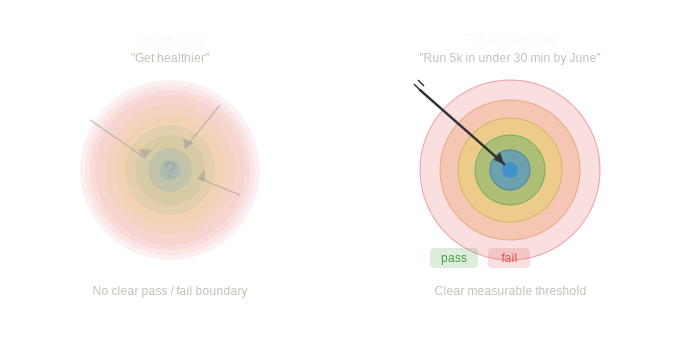
Before anything goes in the cart, write down one specific thing you want to change in the next 90 days.
Not “feel better.” Not “optimize health.” Something you can actually observe and measure.
The physiology behind energy, sleep, recovery, and longevity is different enough that each one points toward a different stack and a different measurement strategy.
Energy and cognitive output
This usually means sustained attention, processing speed, and resistance to fatigue. The upstream targets are often mitochondrial function, methylation efficiency, neurotransmitter precursor availability, or plain old sleep debt wearing a convincing disguise. If you are reaching for adaptogens while sleeping five and a half hours a night, you are tuning the dashboard while the engine is overheating.
Sleep architecture
Think time to sleep onset, overnight awakenings, slow-wave sleep, and morning restoration quality. Sleep is one of the cleanest places to run a structured experiment because changes show up quickly, and bad inputs, like late caffeine, tend to leave obvious fingerprints.
Training recovery
Soreness trajectory, session quality, resting heart rate, and body composition changes over four to eight weeks can all tell you whether a protocol is helping. The feedback loop is short enough that you can learn from a single isolation window instead of waiting half a year.
Longevity and metabolic health
This is where fasting glucose, HbA1c, lipids, inflammatory markers, blood pressure, and omega-3 status come in. The feedback loop here runs in quarters rather than weeks, which means consistent lab work is part of the process, not a bonus feature.
Pick one primary target for your first 90 days. A secondary goal is fine if it is genuinely distinct. Once you chase three outcomes at once, attribution gets muddy fast, and you lose the ability to learn anything useful from the experiment.
The Foundational Layer: Four Compounds With the Deepest Evidence Base
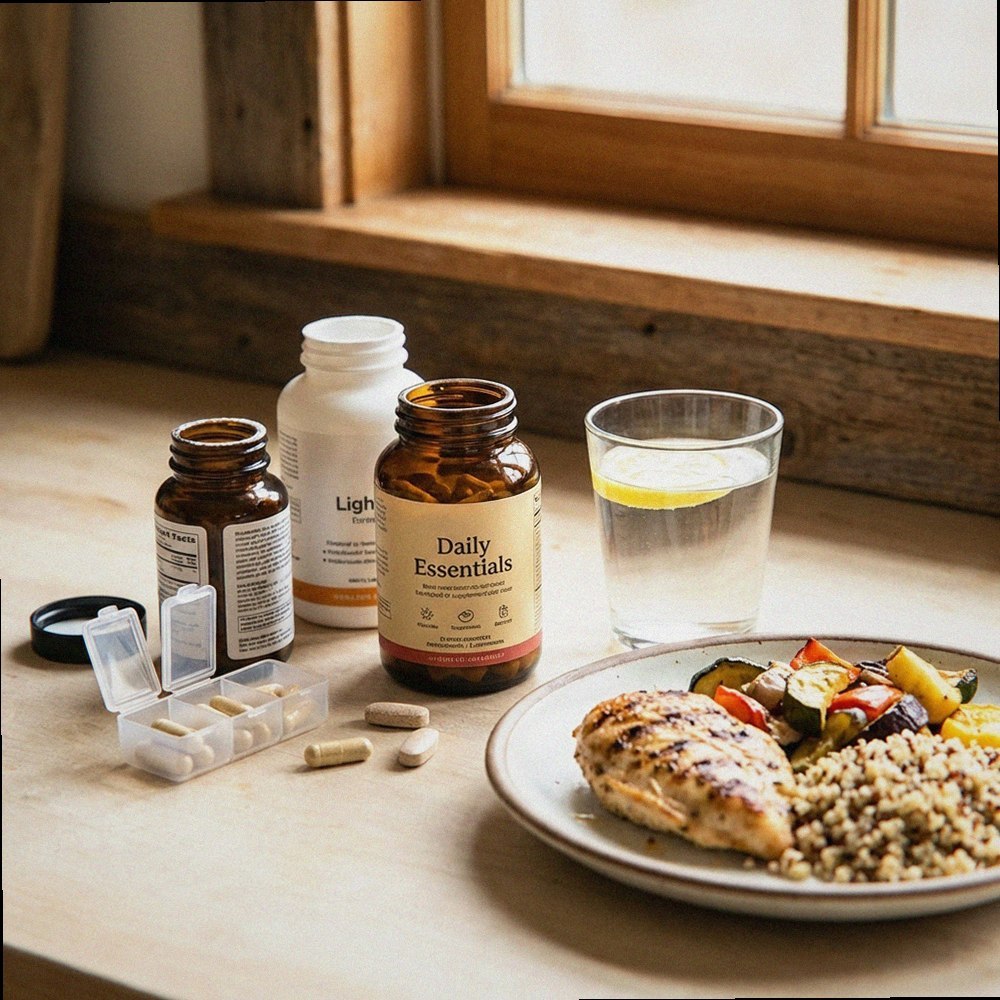
Think of your supplement stack like a recipe. You can experiment with unusual spices, but if the base broth lacks structure, nothing else lands correctly. These four compounds have broad evidence, wide applicability, and enough real-world utility that they belong in the conversation for most people.
One caveat: foundational assumes a gap exists. Someone eating fatty fish three times a week and getting regular sun exposure may need a very different approach from someone indoors all winter in Minneapolis. Assess your diet, geography, and labs before assuming any of these belong in your stack.
Run these alone for about four weeks before adding anything targeted. That gives you a clean baseline and helps you attribute early changes correctly.
Vitamin D3 with K2
A 2011 analysis in Nutrition Research (PMID: 21310306) found roughly 42% of U.S. adults had serum 25(OH)D below 20 ng/mL. Many longevity-focused practitioners aim for a functional range around 40 to 60 ng/mL, and getting there from a deficient baseline usually takes meaningful supplementation.
Research commonly uses 2,000 to 5,000 IU daily, but the right dose depends on your starting level. If you already sit around 55 ng/mL, 5,000 IU may be more than you need. If you are at 18 ng/mL, 2,000 IU may be too conservative. Test first, then dose.
Pair D3 with K2 in MK-7 form at 100 to 200 mcg. K2 activates proteins such as osteocalcin and matrix Gla protein, which help direct calcium toward bone rather than soft tissue. Both are fat-soluble, so take them with a meal that contains fat. A meal with roughly 10 to 15 grams of dietary fat is generally enough to support absorption.
Safety note: Higher-dose vitamin D warrants physician oversight, especially with a history of hypercalcemia, granulomatous disease, or impaired renal function. If you take warfarin or another anticoagulant, discuss vitamin K with your prescriber before starting.
Our Vitamin D3 guide covers target serum ranges and dosing evidence in more detail.
Magnesium
Magnesium participates in more than 300 enzymatic reactions, including ATP synthesis, DNA repair, and neuromuscular signaling. NHANES data from 2005 to 2006 found about 48% of Americans consuming below the estimated average requirement. The pattern is familiar: leafy greens, legumes, and nuts have been displaced by foods that are calorically dense but magnesium sparse.
Form matters. Magnesium oxide has lower bioavailability than chelated forms in most absorption studies, though the gap is not always as dramatic as internet lore suggests. Magnesium glycinate absorbs well and tends to fit evening use because glycine itself has a calming profile. Magnesium threonate has early evidence for preferential CNS penetration, which may make it interesting for cognitive goals.
A reasonable daily range is 200 to 400 mg of elemental magnesium. Glycinate is the default choice for most people.
Safety note: Anyone with impaired kidney function should talk to a physician before supplementing magnesium, since renal clearance is the main route of excretion.
Our Magnesium Glycinate guide covers forms and sleep research in more detail.
Omega-3s, EPA and DHA
EPA and DHA are structural components of cell membranes and influence membrane fluidity as well as the balance of inflammatory signaling molecules. Higher omega-3 index values associate with improved cardiovascular markers, lower triglycerides, and better cognitive aging trajectories across multiple meta-analyses.
Read the supplement facts panel, not the front label. A 1,000 mg fish oil softgel often contains only 300 mg of actual EPA and DHA. Aiming for 1 to 2 grams of combined EPA and DHA daily is a common research-backed range. If your diet already includes fatty fish regularly, you may need less. Testing the omega-3 index directly removes the guesswork.
Look for IFOS-certified products or brands that publish oxidation data such as TOTOX values below 26. Oxidized oil brings lipid peroxides to the party, which is the opposite of what you want.
Safety note: At doses above 2 to 3 grams daily, omega-3s can have measurable antiplatelet effects. If you take anticoagulants, antiplatelet medication, or are approaching surgery, discuss supplementation with your prescriber.
Creatine Monohydrate
Creatine has one of the deepest evidence bases in sports nutrition. Hundreds of controlled trials support its effects on phosphocreatine resynthesis, power output, and lean mass. More recently, a 2022 meta-analysis in Nutrients (PMID: 35268776) found evidence that creatine may support working memory and processing speed, with effects more pronounced under sleep deprivation or cognitive stress.
Three to five grams daily gets you to saturation over several weeks without a loading phase. A loading protocol, around 20 grams daily for five to seven days, accelerates saturation but often causes water retention and GI discomfort. Both paths get to the same destination.
Timing is flexible. Creatine works through chronic saturation, so morning, evening, or around training all make sense.
Safety note: Creatine can raise serum creatinine, which may confuse kidney function interpretation. People with pre-existing renal conditions should consult a physician before use.
Our Creatine Monohydrate guide covers the full evidence review.
Layering Targeted Compounds: One Variable at a Time
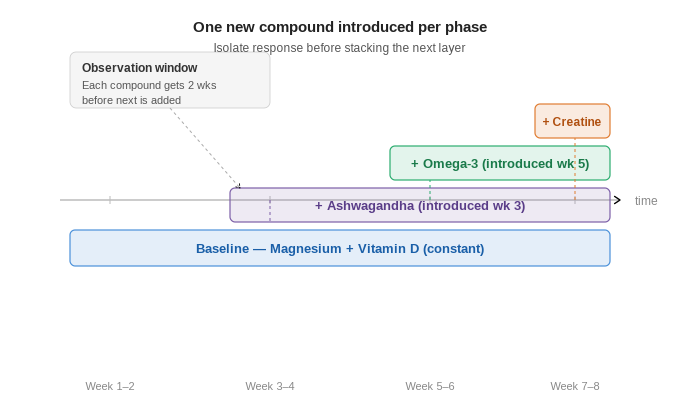
After four weeks on the foundation, you have a baseline. Now add one targeted compound, observe for at least two weeks, and draw a conclusion before touching anything else.
Think of it like a controlled experiment or a financial audit. If every transaction posts at once, nothing is attributable.
For Sleep Architecture
Glycine at 3 grams before bed has a reasonable evidence base. A 2012 study in Sleep and Biological Rhythms (PMID: 23171544) found it reduced daytime sleepiness and improved subjective sleep quality in sleep-restricted subjects, likely by helping the core body temperature drop that precedes sleep onset. It is cheap, well tolerated, and a sensible first add-on.
L-theanine at 100 to 200 mg can support the transition into sleep by increasing alpha-wave activity, a relaxed wakeful state that may ease the edge off without heavy sedation. It pairs well with glycine when racing thoughts are the main issue.
Apigenin at 50 mg before bed has affinity for GABA-A benzodiazepine receptors in preclinical work, which may explain its mild sedative effect. Human trial evidence is limited, so treat it as a reasonable trial, not a settled answer.
Before adding any of the above, check your caffeine cutoff. Caffeine has a half-life of about five to six hours in typical metabolizers, and slower CYP1A2 variants can extend that. A 200 mg dose at 1 PM can still matter at bedtime. Moving the cutoff earlier often costs nothing and pays off immediately.
For Energy and Cognitive Output
Methylated B vitamins, especially methylcobalamin and methylfolate, support one-carbon metabolism and homocysteine clearance. Whether methylated forms outperform standard forms is genuinely contested. The evidence on MTHFR variants is mixed, with some studies showing benefit and others showing little difference. If energy is the goal, check homocysteine and B12 status before assuming a B-complex will solve the problem.
Ubiquinol, the reduced form of CoQ10, at 100 to 200 mg daily supports electron transport chain function. Endogenous CoQ10 synthesis runs through the mevalonate pathway, which statins inhibit, so plasma CoQ10 often drops with statin use. For adults over 40 or anyone on a statin, the rationale is straightforward. Younger adults without statin exposure will usually see less marginal benefit.
For Longevity Protocols
Fisetin and spermidine have attracted real scientific interest for potential senolytic and autophagy-related activity. The honest picture is that the strongest data still comes from cell culture and rodent models, while human trials remain small and underpowered. If you go here, do it with skepticism and rigorous tracking. The placebo effect is especially persuasive when the endpoint is something as abstract as cellular maintenance.
Timing, Absorption, and the Chemistry You Cannot Ignore
Absorption is where good intentions meet biochemical reality.
Fat-soluble compounds, including vitamins A, D, E, K, CoQ10, and omega-3s, absorb better with dietary fat because bile-dependent micellar transport is part of the process. Taking them with black coffee during a fasted morning routine is a recipe for reduced uptake. Pair them with your highest-fat meal of the day.
Water-soluble compounds like vitamin C and most B vitamins absorb without food, though high-dose B-complex on an empty stomach can cause nausea in some people. Zinc taken without food is a reliably unpleasant experience for many people, so a meal is usually the better move.
Mineral competition matters at higher doses. Zinc and copper share intestinal transport pathways, so supplementing above 25 to 30 mg of zinc daily over extended periods may gradually deplete copper. If you run zinc high, 1 to 2 mg of copper daily is a reasonable counterbalance.
How You Actually Know If It Is Working
Placebo response in supplement research regularly reaches 20 to 30% in control groups. Your felt sense of improvement matters, but by itself it cannot tell you whether a compound is working or whether expectation is doing the heavy lifting.
Track the subjective layer in natural language
Structured qualitative notes provide the signal. Write what happened, not a vague score.
“Woke at 3 AM with a racing mind, took 45 minutes to fall back asleep, groggy through noon” is much more useful than “Sleep: 4/10.”
Include context when possible, such as caffeine timing, training load, stress, alcohol, meal timing, and travel. That is where patterns hide.
A real caution here: aggressive sleep tracking can become its own problem. Sleep researchers call this orthosomnia, the anxiety about sleep data that can worsen sleep quality. If you find yourself checking HRV before coffee and letting the number steer your whole morning, loosen the cadence. Weekly review is often better than compulsive daily checking.
Close the loop with biomarkers
Biomarkers make your stack falsifiable.
Serum 25(OH)D confirms whether vitamin D dosing is moving your status.
Homocysteine reflects methylation status.
HbA1c tracks long-term glucose handling.
Omega-3 index shows whether fish oil is actually changing your fatty acid status.
CBC and CMP can help catch broader issues and provide context.
Quarterly testing gives enough resolution to spot trends. Semi-annual testing is a reasonable starting cadence if you are earlier in the process.
Direct-to-consumer panels through services like Ulta Lab Tests or Any Lab Test Now can provide access without a physician order in many states, though pricing and availability vary. Check your local costs before planning a budget around any specific number.
Connect the two data streams
The place where most tracking systems fall apart is connecting what you took, when you took it, how you felt, and what your labs showed over time.
Spreadsheets work until the friction wins. Tools like Micros were built for exactly this kind of problem, letting you log your stack, upload lab PDFs, and surface correlations across both subjective and objective data. When consistent magnesium intake starts lining up with lower resting heart rate or better HRV trends in your Apple Health data, that pattern becomes visible instead of buried in a tab you stopped updating months ago.
A 90-Day Starting Protocol
Weeks 1 to 4, foundation phase
Start with these ranges and adjust based on your baseline labs:
Vitamin D3, 2,000 IU with your highest-fat meal, paired with K2 at 100 mcg MK-7. If labs show deficiency, many practitioners move toward 4,000 to 5,000 IU, but testing before increasing is the more defensible approach.
Magnesium glycinate, 200 to 400 mg elemental, taken 30 to 60 minutes before bed.
Omega-3, 1 to 2 grams combined EPA and DHA with a fat-containing meal, ideally from an IFOS-certified source.
Creatine monohydrate, 3 to 5 grams daily, timing flexible.
Before or during week one, get baseline blood work if you can. A practical starting panel includes 25(OH)D, RBC magnesium if available, omega-3 index, CBC, CMP, and whatever else matches your goal, such as homocysteine or HbA1c.
Log subjective data daily in natural language.
Weeks 5 to 8, first targeted add-on
If sleep is still the bottleneck, add glycine at 3 grams before bed and hold everything else steady for two weeks.
If energy is still flat despite decent sleep, check homocysteine, B12, ferritin, and thyroid markers with a clinician before reaching for stimulants or adaptogens.
Weeks 9 to 12, review and refine
Look at the combination of logs and labs. Ask three questions:
Did the intervention move the biomarker I expected?
Did it change how I actually felt or performed?
Was the change large enough to justify keeping it?
If the answer to the first two is no, the compound probably does not belong in your stack. If the answer to one is yes and the other is no, you may have a useful clue, but not yet a keeper.
Your Stack Is a Living Document
Physiology shifts. Training load changes, seasonal light exposure fluctuates, stress accumulates, and the body at 45 runs on different parameters than it did at 35. A protocol that worked in one chapter of your life may need a rewrite in the next.
That is why tracking matters. Each data point sharpens the next decision. Instead of starting over every time a promising compound shows up on a podcast, you have a record of what you tried, what your labs said, and what your body actually did with it.
Build the foundation. Run isolation windows. Test the biomarkers. Let the data overrule intuition when they disagree.
Start tracking your stack and lab results with the Micros iOS app or the web dashboard.