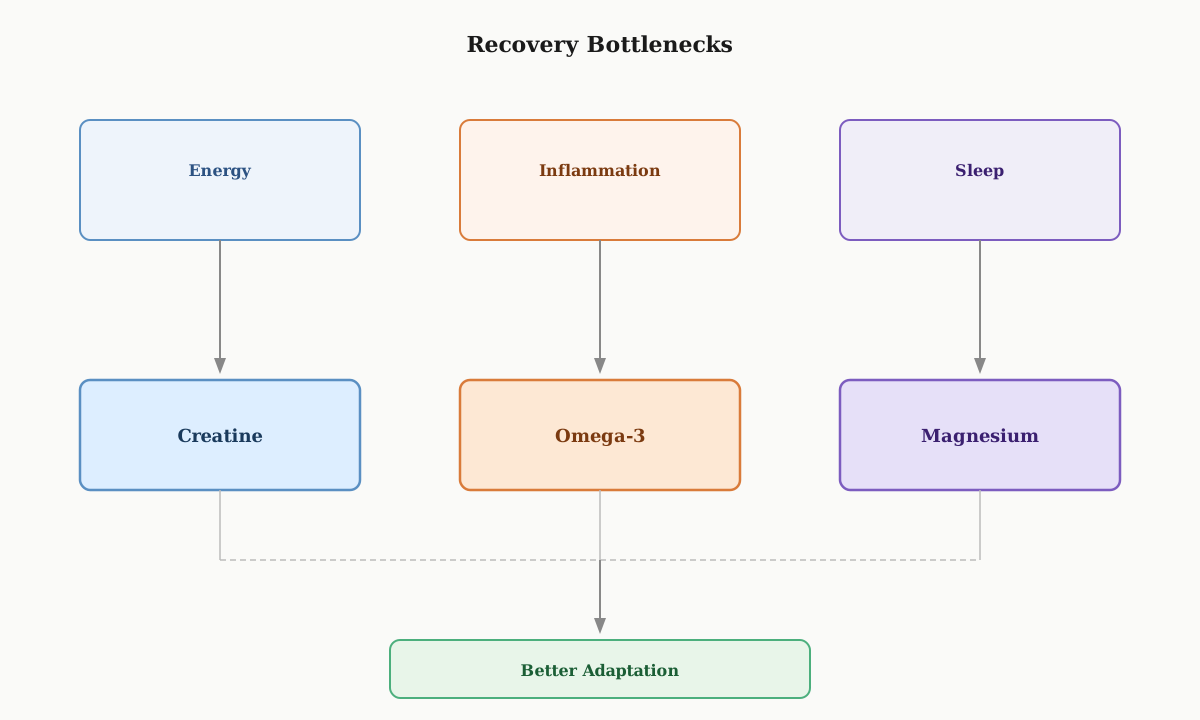
Recovery has three main bottlenecks that diet alone often does not cover when training load is high: ATP resynthesis capacity, inflammatory resolution rate, and nervous system downregulation...
The Creatine, Omega-3, Magnesium Recovery Stack: Mechanisms, Dosing, and What to Track
Recovery has three main bottlenecks that diet alone often does not cover when training load is high: ATP resynthesis capacity, inflammatory resolution rate, and nervous system downregulation. Creatine, omega-3 fatty acids, and magnesium each address one of those bottlenecks through separate mechanisms.
The stack is simple. The details matter more than most write-ups acknowledge. A lot of people run it for weeks and notice nothing because they are using the wrong forms, under-dosing, or starting without a baseline to measure against.
This article covers the mechanisms, practical dosing, relevant biomarkers, and how to tell whether the stack is doing anything in your specific physiology.
Creatine Monohydrate: ATP Buffer and Post-Session Repair
Creatine is usually discussed in the context of strength output, but its recovery relevance is just as strong. The phosphocreatine system regenerates ATP during high-intensity effort. When that buffer runs low, contractile function degrades and cellular repair processes slow in parallel. Maintaining creatine saturation keeps that buffer available during training and in the hours of active repair that follow.
There is also a cognitive recovery angle. The brain consumes ATP at a rate disproportionate to its mass, and some research suggests creatine supplementation may attenuate cognitive fatigue under sleep deprivation. That matters for people training hard while sleep quality is already under pressure.
Form: Creatine monohydrate. No other commercially available form has demonstrated superior absorption or efficacy in peer-reviewed literature.
Dosage: 5 grams daily. Loading at 20 grams per day split across four doses for 5 to 7 days does accelerate saturation, but it can also cause water retention and GI bloating, which matters if you are weight-class sensitive or just find it uncomfortable. Without loading, full muscle saturation takes about 3 to 4 weeks of consistent daily intake.
Timing: Post-workout or with an evening meal are both reasonable. The evidence on timing is not strong enough to treat it as a precision variable. Consistency matters more than the window.
Biomarker note: Serum creatinine typically rises modestly with creatine supplementation. Creatinine is a metabolic byproduct of creatine breakdown, and in healthy individuals without pre-existing renal issues, this elevation is generally considered benign. If you are tracking kidney function panels, note this so it is interpreted in context rather than in isolation.
For deeper detail on saturation timelines and the interaction with caffeine, see the creatine supplement guide.
Omega-3 Fatty Acids: Inflammatory Resolution, Not Suppression
Physical stress triggers an inflammatory cascade. That cascade is required for adaptation. The recovery problem comes from the resolution phase. When it is slow or incomplete, tissue repair stalls and the next session begins with a higher inflammatory baseline.
EPA and DHA integrate into cell membrane phospholipids and influence the production of specialized pro-resolving mediators, signaling molecules that actively promote resolution rather than simply blocking the inflammatory signal. This mechanism differs from NSAIDs, which broadly inhibit cyclooxygenase activity. Omega-3s work with the resolution process rather than interrupting it, which is why they are more compatible with training adaptation than chronic NSAID use.
EPA gets more attention in anti-inflammatory research, but most clinical supplementation studies use combined EPA/DHA products. For recovery applications, total combined intake matters more than the ratio.
Form: Triglyceride-form fish oil or algae-based EPA/DHA. Ethyl ester forms are cheaper and absorb less efficiently, especially in a fasted state. Look for a TOTOX score below 26 when possible. Oxidized fish oil generates lipid peroxides that add oxidative load rather than reduce it. Storage matters too. Heat and light accelerate oxidation after purchase.
Dosage: 1 to 2 grams of combined EPA and DHA daily. The supplement facts panel lists actual EPA and DHA content separately from total fish oil weight. A 3-gram capsule may contain anywhere from 900 mg to 2,400 mg of combined EPA/DHA depending on concentration.
Timing: With meals. Fat-soluble absorption improves with dietary fat present, and food reduces gastric distress for most people.
Biomarkers: The Omega-3 Index measures EPA and DHA incorporation into red blood cell membranes. It reflects tissue status over roughly 90 days, which makes it more useful than a single serum draw. Research from multiple large observational studies and some interventional trials associates an index of 8 to 12 percent with favorable cardiovascular and inflammatory outcomes, though much of the cardiovascular data comes from observational cohorts rather than controlled trials. hs-CRP tracks systemic inflammatory load and is worth pairing with the Omega-3 Index if you want to know whether your current dose is doing anything.
One tradeoff to know: High-dose omega-3s, above 3 grams of combined EPA/DHA daily, have antiplatelet effects. If you are on anticoagulants or antiplatelet medications, that interaction is worth discussing with a physician before escalating dose. At 1 to 2 grams daily, this is generally a non-issue for healthy individuals.
For more detail on forms and sourcing, see the omega-3 supplement guide.
Magnesium: Sleep Architecture and Nervous System State
Magnesium functions as a cofactor in more than 300 enzymatic reactions, including those involved in neurotransmitter synthesis, GABA receptor activity, and calcium-magnesium competition in skeletal and smooth muscle. The recovery relevance is less about direct muscle relaxation and more about the downstream conditions that allow sleep onset and maintenance to proceed normally. If sleep architecture is disrupted by something other than magnesium status, supplementation will not fix it.
Subclinical deficiency is common among athletes and high-volume trainers. Physiological stress increases urinary magnesium excretion, and many people do not consistently hit dietary targets through food. Whether soil depletion contributes meaningfully at a population level is debated, but exercise-driven losses are well documented.
Form: Magnesium glycinate is worth knowing about for two reasons. First, the glycinate chelate has reasonable bioavailability compared with inorganic forms like oxide. Second, it is less likely to cause the osmotic laxative effect that oxide and high-dose citrate can produce by drawing water into the intestine. Magnesium oxide has poor absorption and its primary clinical use is as a laxative. Magnesium threonate has attracted interest for cognitive applications because of reported preferential transport across the blood-brain barrier, but the clinical evidence base is smaller and the elemental magnesium content per capsule is low relative to cost.
Dosage: 200 to 400 mg of elemental magnesium daily. Labels list compound weight, not elemental content. Glycinate typically delivers around 14 percent elemental magnesium by weight, so a 500 mg glycinate capsule contains roughly 70 mg of elemental magnesium. Check the label before assuming the dose.
Timing: 30 to 60 minutes before bed.
Biomarker note: Serum magnesium is a poor proxy for tissue status. The body maintains serum levels within a tight range by pulling from intracellular and bone stores, so a normal serum result can coexist with meaningful tissue depletion. RBC magnesium reflects intracellular status more accurately. If you have been supplementing consistently for 4 to 6 weeks and notice no change in sleep quality or muscle recovery, RBC magnesium is worth testing before increasing the dose.
See the magnesium supplement guide for a fuller breakdown of forms and absorption rates.
How the Mechanisms Fit Together
Creatine addresses energy availability at the cellular level. Omega-3s support the resolution of inflammatory signaling after training stress. Magnesium facilitates the nervous system state that makes deep sleep possible. These are distinct mechanisms acting on different rate-limiters. There are no known adverse interactions between them at standard doses.
The more useful question is whether the stack produces measurable changes in your physiology, and that question is harder than it looks. Subjective recovery and physiological recovery often diverge. HRV can remain suppressed while you feel fine. hs-CRP can trend downward before any subjective signal registers. Running this stack without baseline measurements means adjusting based on day-to-day mood rather than trend data, which is a weak feedback loop.
A practical logging structure: daily dosages alongside morning HRV, sleep duration, and a brief readiness or soreness rating. At week 4, check whether HRV is trending upward under stable training load. At week 12, compare hs-CRP, RBC magnesium, and, if you want the full picture, the Omega-3 Index against your starting values.
Micros Tracker is built for exactly this kind of longitudinal correlation, supplement inputs, lab uploads, and Apple Health data like HRV and sleep in one place. The value is not just storage, it is pattern detection across multiple inputs over time, which is where decisions about dose, form, and timing get clearer. You can start at microstracker.com or download the iOS app.
The Non-Responder Problem
A realistic note before the protocol: a meaningful percentage of people run this stack for 8 to 12 weeks and notice nothing. Some of that is fixable.
Omega-3 non-response is often a dosing or form issue. Ethyl ester at 1 gram of combined EPA/DHA in a fasted state is a very different input than triglyceride-form at 2 grams with a fat-containing meal.
Magnesium non-response frequently reflects using oxide, or misreading elemental content on the label.
Creatine has genuine non-responders, estimated at around 20 to 30 percent of users in muscle phosphocreatine saturation studies. Baseline dietary creatine intake and individual physiology likely explain some of that spread. If creatine is not moving the needle after 4 weeks of consistent use, that may simply be your physiology rather than a dosing error.
The point of tracking is to distinguish between “this compound does nothing for me” and “I was using the wrong form at the wrong dose.” Those are different conclusions, and they lead to different next steps.
Starting Protocol
Weeks 1 through 4: Establish baseline consistency before changing anything else
- Creatine monohydrate: 5 grams daily, post-workout or with dinner
- EPA/DHA: 1 to 2 grams combined, with the largest meal of the day
- Magnesium glycinate: 300 mg elemental, 30 to 60 minutes before bed
Hold training load stable during this period. Changing volume or intensity at the same time makes it hard to attribute any observed change to the stack.
Track daily:
- Morning HRV via any validated wearable or HRV app
- Sleep duration and subjective quality upon waking
- Readiness or soreness on a 1 to 5 scale
At week 12, compare against baseline:
- hs-CRP for systemic inflammatory status
- RBC magnesium for tissue repletion
- Omega-3 Index if you want to confirm EPA/DHA incorporation
If hs-CRP has not shifted after 12 weeks of consistent omega-3 intake, consider whether the baseline inflammatory load has a dietary or lifestyle driver that supplementation alone cannot address, or whether the dose needs to move toward 3 grams of combined EPA/DHA. Keep the bleeding-risk tradeoff in mind at higher doses if relevant.
If RBC magnesium remains low, the form or elemental dose calculation is the most likely culprit before assuming you are a non-responder.
Sleep, training periodization, and dietary adequacy still set the ceiling on recovery. Creatine, omega-3s, and magnesium work at the margins of what those fundamentals allow. The question worth asking after 12 weeks of clean data is simple: are those margins actually moving in your numbers, or are you maintaining a protocol out of habit rather than evidence?
Start with one clean run, log the inputs, and see what changes.