
The sympathetic nervous system does not distinguish between a max-effort squat and a deadline that kept you awake until midnight. Both draw on the same physiological reserve. Both cost recovery capacity.
Why Recovery Stalls When Everything Looks Fine on Paper
Training load is scheduled. The stack is deliberate. Sleep hours are there. And yet HRV has been sliding for two weeks, afternoon focus collapses reliably around 2 PM, and workouts feel like wading through concrete.
The reflex is to edit the stack. Maybe a different adaptogen, a better magnesium form, a new recovery compound. That reflex is usually wrong, because the gap here is rarely a missing supplement. More often, total stress load, training plus cognitive plus emotional, has exceeded what the system can absorb, and no compound reliably closes that gap until the load itself changes.
This piece is about how to read that situation accurately, what the data actually tells you, and how to test interventions without fooling yourself.
The Shared Budget Between Training and Everything Else
The sympathetic nervous system does not distinguish between a max-effort squat and a deadline that kept you awake until midnight. Both draw on the same physiological reserve. Both cost recovery capacity.
Experienced athletes track physical load with precision: volume, intensity, frequency, deload timing. That same precision rarely gets applied to cognitive and emotional load. A sustained work crunch, a disrupted sleep environment, or weeks of accumulated low-grade pressure lands on the same HPA axis that has to clear training stress. When the combined draw exceeds what the system can restore overnight, something starts slipping.
The signal is usually subtle at first. Focus starts fragmenting earlier in the afternoon. Sleep duration looks adequate but quality degrades. Workouts feel harder at the same RPE. Motivation flattens. Most people diagnose this as underrecovery from training and add volume to a deload, when the actual load they needed to reduce was sitting in their calendar.
One practical way to see this: if your HRV baseline drops during a low-training week when work pressure is high, that is the signal. Training volume did not change. Something else did. That is the distinction worth tracking.
Cortisol Rhythm Matters More Than Any Single Value
Cortisol is not a problem to suppress. It drives the cortisol awakening response, mobilizes glucose, sustains attention, and regulates acute inflammation. A disrupted rhythm is the problem, not the hormone.
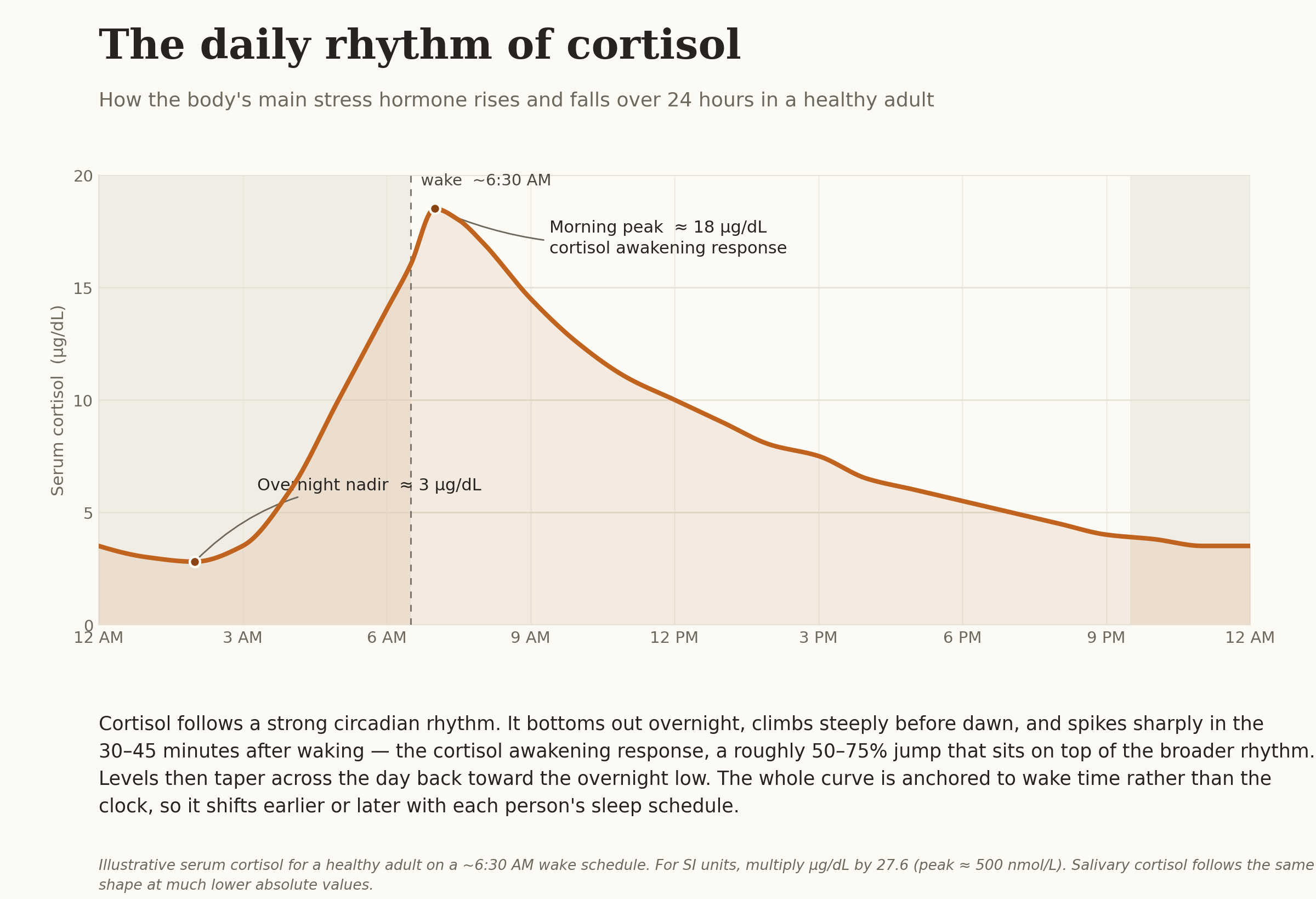
The standard single-draw serum test, typically done at 8 AM, captures one point on a curve and tells you very little about what that curve is doing across the day. A four-point saliva test, collected at waking, noon, late afternoon, and bedtime, gives you the shape of the rhythm. Saliva cortisol is measured in nmol/L or ng/mL, not the mcg/dL units of a serum draw. Reference ranges differ between matrices, so compare results against the specific lab's saliva ranges, not serum norms.
The patterns worth knowing:
High morning, high evening: Associated with acute stress load or fragmented sleep architecture. The system is not downregulating when it should.
Flat across the day: Seen in longer-term burnout states. The morning peak is blunted, the diurnal drop is minimal. This is a different problem than a high-evening spike and calls for different interventions.
Low morning, elevated later: Can reflect HPA-axis disruption from chronic sleep pressure, shift work, or timing of compounds that suppress the morning response.
Two compounds have reasonable evidence here. Phosphatidylserine at 400 mg has some support for blunting exercise-induced cortisol spikes, particularly when the problem is elevated output later in the day. Ashwagandha, specifically KSM-66 or Sensoril extracts at 300 to 600 mg daily, shows modest reductions in perceived stress and cortisol in trials running 8 to 12 weeks. Worth noting: ashwagandha has documented thyroid interactions and some users report anhedonia or emotional blunting with extended use. Cycling it and monitoring subjective mood alongside any cortisol marker is more useful than treating it as a permanent stack addition. Rhodiola rosea at 200 to 400 mg standardized extract shows some evidence for fatigue under combined cognitive and physical stress, but it can feel activating and may worsen sleep if taken late. These are tools with tradeoffs, not clean solutions.
Reading HRV and RHR Without Overinterpreting Either
HRV is a recovery signal, not a performance score. A single low reading is noise. A consistent 10 to 14 day downward trend while training volume holds steady is meaningful.
Resting heart rate follows similar logic. Five to ten beats above your stable baseline across several consecutive days means the system is loaded. HRV and RHR will not tell you whether the cause is accumulated training fatigue, early illness, elevated life stress, or poor sleep. They tell you that recovery is under pressure and that adding load is probably the wrong move.
Your own stable baseline during a normal training block with adequate sleep and manageable life demands is the reference point. Population averages are not useful here because they average across wildly different individuals. Two weeks of daily morning HRV readings during a genuinely low-stress period gives you a real floor to measure against. Without that baseline, the numbers are directionally useful but lack context.
hs-CRP and What It Actually Tells Athletes
High-sensitivity CRP reflects systemic inflammatory tone and is one of the more accessible markers for tracking inflammation over time. Rough reference ranges:
Under 1.0 mg/L: Low systemic inflammation
1.0 to 3.0 mg/L: Intermediate
Above 3.0 mg/L: Elevated
For athletes in heavy hypertrophy or endurance blocks, hs-CRP frequently rises above 3.0 mg/L from exercise-induced inflammation alone. That is not pathological. The relevant question is whether it stays elevated after a deload or recovery week. Training-induced hs-CRP should normalize within a few days to a week of reduced load. Persistent elevation after deloading, or elevation during a low-volume period, is a different signal and worth investigating further.
Context matters as much as the number. An hs-CRP of 2.4 mg/L at the peak of a training block, returning to 0.7 mg/L after a deload, describes a normal adaptive response. The same 2.4 mg/L during a rest week, after a period of elevated stress, is worth taking seriously.
Other markers can add context when the picture is unclear. Ferritin is worth including if heavy training volume coincides with low energy and sluggish recovery. Iron is required for oxygen transport via hemoglobin and myoglobin, for mitochondrial enzyme function, and for thyroid hormone conversion. Depleted ferritin, even without frank anemia, can blunt all three. If your ferritin is running below 30 to 40 ng/mL and recovery feels off, that is a more actionable finding than chasing marginal cortisol optimization.
Subjective Check-Ins Move Before Labs Do
Objective data feels cleaner, but subjective signals often shift first. Motivation, libido, focus quality, morning readiness, and the sense of waking unrefreshed despite adequate sleep hours are early indicators. HRV may not catch up for several days.
A simple daily check-in, rating energy, focus, mood, sleep quality, and perceived stress on a 1 to 10 scale, produces a dataset that is surprisingly useful when reviewed across two to three weeks. The value is not in any single day's numbers. It is in seeing which subjective markers lead versus lag the objective ones. Focus may track more tightly with sleep disruption than with training volume. Energy may start dropping four days before HRV follows. That lead-lag relationship is genuinely useful for knowing how early to intervene.
The limitation of this approach is that the patterns are nearly impossible to see when your supplement log lives in one place, wearable data in another, and lab results in a PDF folder somewhere. Micros Tracker is built to put those layers on the same timeline, so you can see whether a change in sleep quality preceded or followed an HRV shift, and whether that correlated with what you added or removed from the stack. The point is pattern detection, not data collection for its own sake.
Measuring Recovery Capacity, Not Just Recovery Events
"Recovery capacity" is a meaningful concept that becomes vague without a metric attached to it. A practical definition for tracking purposes: the gap between your stable HRV baseline and your current HRV trend, expressed over a rolling 7 to 14 day window. When current HRV is within 5 to 10% of baseline and subjective scores are stable, capacity is roughly matched to load. When HRV runs more than 10 to 15% below baseline for multiple days and subjective energy and focus are also declining, load has exceeded what the system is absorbing.
That gap is what you are actually managing. Supplements can narrow it at the margins. Reducing load closes it faster. Knowing which is happening requires the timeline.
Testing Interventions Without Losing the Signal
Most people lose the signal because changes stack on top of each other. A new supplement, a harder training week, a sleep disruption, and a stressful project all happen at once, and then three weeks later there is no way to know what moved the marker.
A cleaner protocol:
Weeks 1 to 2: Hold the stack and training load constant. Log daily subjective scores. Establish your actual baseline for this period, not a theoretical one.
Week 3 onward: Add or remove one variable. Keep everything else stable for at least two full weeks before drawing conclusions. For compounds like ashwagandha that operate over longer horizons, four to six weeks is a more honest evaluation window.
Lab timing: hs-CRP has a short half-life but reflects inflammatory trends that can take weeks to shift meaningfully. Recheck it after a full training block or after a sustained deload, not after a single good week.
What to watch: Did the subjective markers move before HRV did? Did hs-CRP normalize after the deload? Did focus improve before or after sleep quality changed? The sequence matters as much as the outcome.
If you have been logging data in Micros Tracker across a protocol, the supplement stack tracking workflow walks through how to structure intervention periods so the timeline stays readable.
A Concrete Starting Point for the Next Two Weeks
Before adding anything to the stack, try this:
Log energy, focus, mood, sleep quality, and perceived stress daily using a simple 1 to 10 scale. Compare those ratings against training load and work demands at the end of each week.
Watch HRV and resting heart rate as trends across the two weeks, not day to day.
If you have not run labs recently, add hs-CRP and ferritin to the next draw.
If cortisol testing is on the table, use a four-point saliva panel rather than a single serum draw, and compare results against the saliva-specific reference ranges from the testing lab.
If that two-week picture shows declining subjective scores alongside falling HRV during a period where training load did not change, pull training volume back by 20 to 30% for two weeks before adding any compound. Track what happens to sleep quality, morning readiness, and focus during that reduction. That experiment will tell you more about where the bottleneck actually sits than any addition to the stack.
The thing worth knowing at the end of this is not whether your protocol is complete. It is whether your recovery plan accounts for total load or just the hours you spent in the gym.
For a deeper look at magnesium forms, timing, and dosing relative to sleep and HPA-axis function, see the magnesium forms and timing guide. For context on building a usable HRV baseline from scratch, the HRV baseline tracking guide covers the setup in practical terms.