
The 0.5 mg vs 3-5 mg melatonin debate is mostly about milligrams. A 2024 meta-analysis of 26 trials found that timing predicted sleep onset too, and the few head-to-head studies show dose and timing trading off against each other.
You probably have a bottle of 3, 5 or 10 mg tablets on the nightstand, and you take one when the lights go off. At some point a forum thread or podcast told you that 0.5 mg is the real dose and that anything above it is wasteful or leaves you groggy. Both positions are arguments about milligrams.
What did the dose-response meta-analysis find?
The 2024 paper is a systematic review and dose-response meta-analysis of double-blind RCTs of exogenous melatonin in people with insomnia and in healthy volunteers. It pooled 26 trials published between 1987 and 2020, totaling 1689 observations, and compared melatonin against placebo on sleep onset latency (SOL) and total sleep time (TST) (PMID 38888087). As dose rose, melatonin gradually reduced SOL and increased TST, and the effect peaked at 4 mg/day. The curve did not flatten at half a milligram, so this result does not support the claim that 0.5 mg is optimal and more is pointless.
That result also does not make 4 mg the correct dose. The outcomes are standardized mean differences, a unitless effect size, so the headline result cannot tell you how many minutes faster you fall asleep at 4 mg compared with 1 mg. A peak in a pooled curve describes the average across heterogeneous trials. Your personal curve could peak lower or higher than that, or it could be flat.
Where does the 0.5 mg claim come from, and what has been tested?
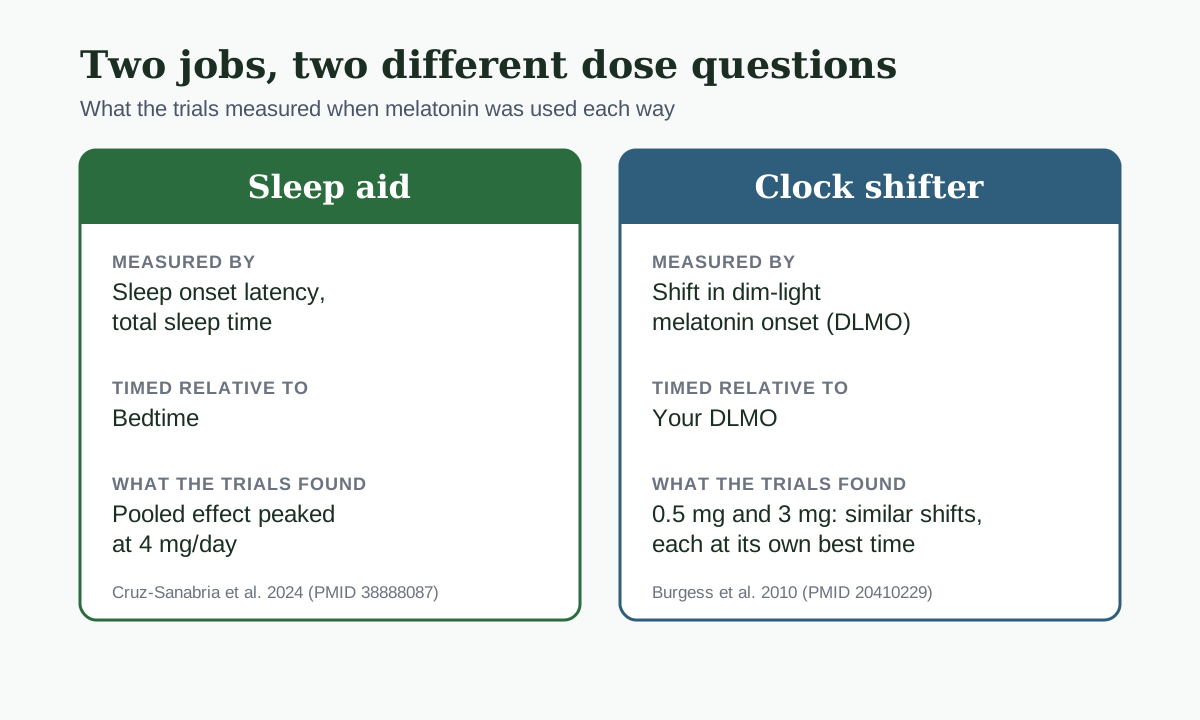
The 0.5 mg position is not baseless. Much of it comes from melatonin's other job, which is circadian phase shifting. Under the phase shift hypothesis for winter depression, people whose rhythms run late should respond to low-dose melatonin in the afternoon or evening, because it advances their phase in a corrective direction (PMID 20160896). In that framework the dose is small and the timing is set relative to dim-light melatonin onset (DLMO), not relative to lights-out. A sleep-onset effect and a phase-shift effect follow different logic, and much of the 0.5 mg versus 3-5 mg debate treats them as the same thing.
Head-to-head comparisons are rare, but a few exist. In an MIT trial, adults over 50 took a placebo and three melatonin doses (0.1, 0.3 and 3.0 mg) 30 minutes before bed, a week at a time (PMID 11600532). In the 15 participants with poor sleep efficiency, 0.3 mg restored sleep efficiency and brought plasma melatonin up to the normal nighttime range. The 3.0 mg dose also improved sleep, but it lowered body temperature and left plasma melatonin elevated into the daylight hours. The 15 participants who already slept normally saw no change on any dose. The trial measured blood levels, not how groggy people felt the next morning, so it shows that the larger dose lingered without showing that it caused grogginess.
For phase shifting, a lab study gave healthy adults 0.5 mg and compared the result with an earlier 3.0 mg study run on the same protocol (PMID 20410229). When each dose was taken at its own best time, the two produced similarly sized shifts in DLMO. The best time was later for the lower dose: the largest advances with 0.5 mg came when it was taken in the afternoon, 2-4 hours before DLMO. In that setting, dose and timing traded off against each other.
Does timing predict sleep onset as well as dose?

The largest recent pooled analysis of melatonin trials found that the gap between taking the pill and going to sleep was a significant predictor of sleep onset in its own right (PMID 38888087). That makes the clock a second variable you can track alongside dose. In the meta-regression, the time between administration and the sleep episode significantly predicted SOL (β = -0.16, p = 0.023), meaning that a longer lead time was associated with faster sleep onset. For TST, time of day was the only significant predictor (β = -0.086, p < 0.01). Dose did not reach significance as a predictor of TST in that model, and the clock did.
Insomnia status also predicted SOL (β = 0.50, p < 0.001), and that coefficient is larger than the timing coefficient (PMID 38888087). It suggests that melatonin's effect on sleep onset differs between people with insomnia and healthy volunteers. If you already fall asleep within 15 minutes and take melatonin out of habit, the pooled curve probably overstates what you have to gain, because a floor effect leaves little SOL to remove. If you regularly lie awake for 45 minutes, you belong to the population where the measured effect was different, and differences in dose and timing are more likely to show up in your data. The abstract reports that the effect differs by group, but it does not report the direction or size of the difference in a form you can translate into minutes.
The authors conclude that taking melatonin about 3 hours before the desired bedtime at 4 mg/day, compared with the schedule most used in clinical practice (2 mg taken 30 minutes before bedtime), might improve its effect on sleep (PMID 38888087). They also open the paper by acknowledging that earlier studies produced inconsistent results, which they attribute partly to differences in dose and schedule across trials. The pooled trials span three decades, use different formulations and protocols, and mix insomnia patients with healthy volunteers. The 3-hour figure is a hypothesis to compare against your own logged lead times, not an established rule.
Do the adult and pediatric meta-analyses agree?
A 2025 meta-analysis in children with neurological and psychiatric conditions points in a similar direction (PMID 40914024).
2024 adult meta-analysis (PMID 38888087) | 2025 pediatric meta-analysis (PMID 40914024) | |
|---|---|---|
Population | People with insomnia and healthy volunteers | Children with neurological and psychiatric conditions |
Size | 26 RCTs, 1689 observations | 21 studies, literature searched up to April 30, 2024 |
Improved vs placebo | SOL and TST | SOL, sleep efficiency and TST |
Dose at maximal effect | Peak at 4 mg/day | 2-4 mg/day |
Timing and SOL | Time between administration and sleep episode predicted SOL (β = -0.16, p = 0.023) | Earlier dosing relative to bedtime associated with shorter SOL |
Authors' suggested schedule | About 3 hours before desired bedtime at 4 mg/day, vs the common 2 mg taken 30 minutes before bed | 2-4 mg, 3 hours before bedtime, pending large trials |
Other finding | Time of day was the only significant predictor of TST | Longer treatment duration associated with gains in sleep efficiency and TST |
Both pooled analyses put maximal efficacy in the same low-single-digit milligram range, and both link earlier dosing to shorter SOL. The pediatric authors call their suggested schedule hypothesis-level, something that could guide practice only "if replicated by large clinical trials." These were children with neuropsychiatric diagnoses, so the numbers do not carry over to a healthy adult. The two papers also come from the same research group at the University of Pisa and use the same dose-response methods, so their agreement is not fully independent. The value is that two separate sets of trials point the same way on timing.
When does melatonin act as a phase shifter instead of a sleep aid?
The phase-shift use works on a different principle. In ADHD, DLMO runs about 45 minutes late in children and about 90 minutes late in adults. Delayed sleep-wake timing occurs in up to 78% of people with ADHD, and up to 80% of adults with ADHD report insomnia or disturbed sleep (PMID 41450833). Melatonin and bright light have both advanced DLMO in this group, and emerging data link the size of the advance to symptom improvement. That effect comes from moving the clock, separate from any acute sedation at bedtime. The winter depression literature adds that a subgroup is phase advanced rather than delayed (PMID 20160896), and in that subgroup an evening dose meant to advance the rhythm would push it in the wrong direction. If your problem is that your sleep window sits at the wrong time, rather than that you lie awake once you get into bed, the timing question follows phase-shift logic, where the direction of misalignment matters. That is a question to bring to a clinician.
How can you track your own melatonin dose and timing?
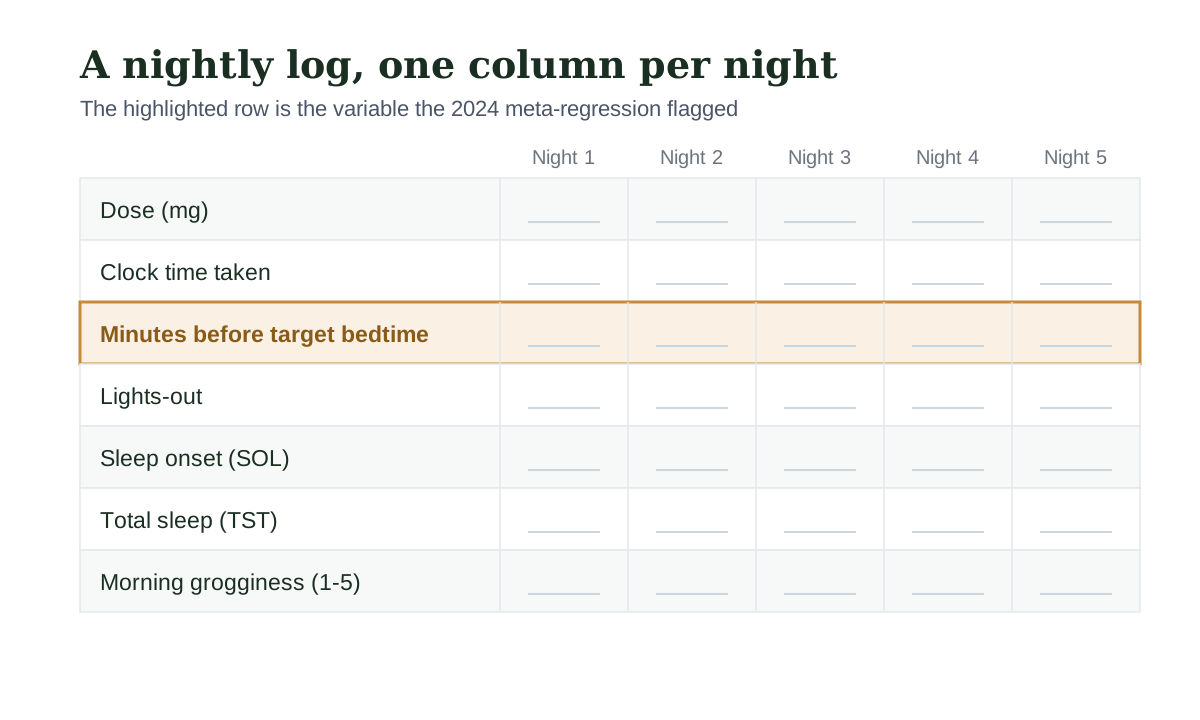
A useful log has these fields for every night: dose in mg, the clock time you took it, minutes before your target bedtime, actual lights-out, SOL and TST from your wearable, and a one-line morning check-in rating grogginess on a 1-5 scale. The minutes-before-bedtime field matters most because it is the variable the meta-regression flagged, and most people never record it.
Micros stores each dose in mg with the time you logged it, pulls nightly sleep duration from Apple Health on iPhone, and keeps your morning check-ins on the same timeline, so you can compare nights side by side without stitching spreadsheets together. Sleep onset and minutes before bedtime are not separate fields, so add them to your check-in note. For background on forms and interactions, see the melatonin supplement guide, and for the wider picture, Sleep Is the First Recovery Lever.
Start with 7 nights of logging at your current dose and current timing so you have a baseline. As more nights accumulate, group them by minutes before target bedtime and compare average SOL, TST and morning grogginess between the groups, looking at the spread across nights as well as the averages. If lead time shows no visible difference in your data, group the same nights by dose instead. Bring what the log shows, along with your questions about dose and timing, to a clinician.