
Most people running serious supplement protocols have the inputs dialed. The creatine is dosed. The magnesium form is correct. The methylated B12 is timed. And yet HRV trends down across a training...
Sleep Is the First Recovery Lever
Most people running serious supplement protocols have the inputs dialed. The creatine is dosed. The magnesium form is correct. The methylated B12 is timed. And yet HRV trends down across a training block, resting heart rate sits two beats above baseline, and subjective energy stays flat despite everything looking right on paper.
Before adding another compound, ask whether the foundation is actually stable. Sleep is where adaptation happens, and it is still the variable that gets the least rigorous attention from people who track everything else.
This is not a sleep hygiene primer. It is about applying the same protocol logic to sleep that you already apply to supplementation: define the inputs, understand the mechanisms, measure the outputs, and make decisions based on what the data actually shows.
What Sleep Is Actually Doing
The physiology matters because it explains why behavioral and supplement decisions have the effects they do.
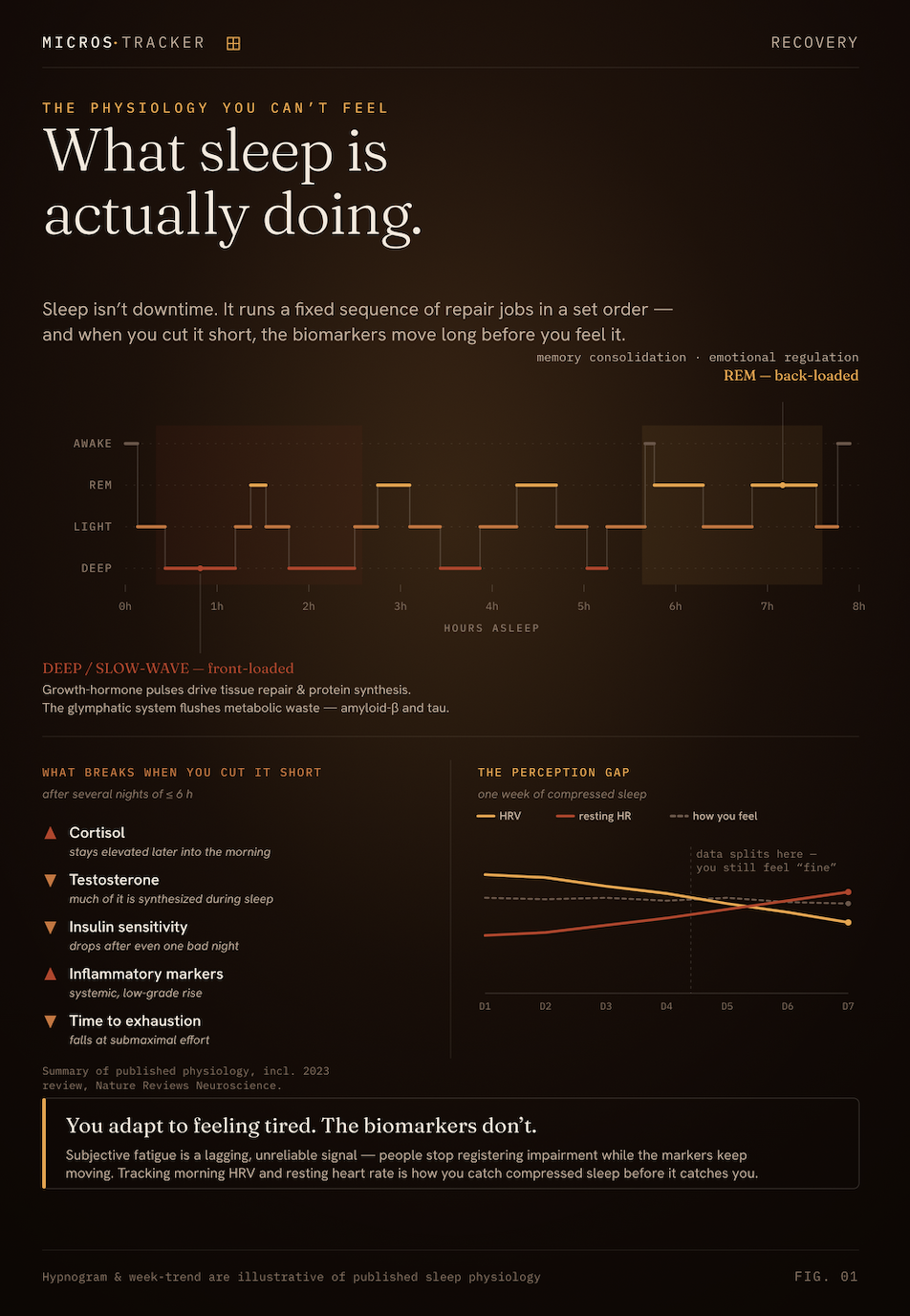
During slow-wave sleep, the pituitary releases growth hormone in pulses that support tissue repair and protein synthesis. REM sleep supports memory consolidation and emotional regulation. The glymphatic system, which clears metabolic byproducts from the central nervous system including amyloid-beta and tau proteins, is primarily active during sleep and depends heavily on adequate slow-wave duration.
When sleep is shortened or fragmented, the downstream effects are measurable before they become obvious subjectively. Cortisol rises and stays elevated longer into the morning. Total testosterone production drops because much of daily testosterone synthesis occurs during sleep. Insulin sensitivity worsens after even a single night of poor sleep, and a 2023 review in Nature Reviews Neuroscience summarized evidence showing that partial sleep restriction, defined as six hours or fewer across multiple nights, impairs glucose metabolism, increases inflammatory markers, and reduces time to exhaustion at submaximal exercise intensities.
Subjective perception is a poor proxy for these changes. People adapt to feeling tired and stop registering impairment accurately. The biomarkers keep moving.
If you are tracking morning HRV and resting heart rate, you have probably already seen this pattern. A week of compressed sleep tends to produce a downward HRV trend and elevated resting heart rate before fatigue becomes subjectively obvious. That gap between how you feel and what the data shows is exactly why sleep and recovery tracking changes decisions.
The Environmental Variables Worth Quantifying
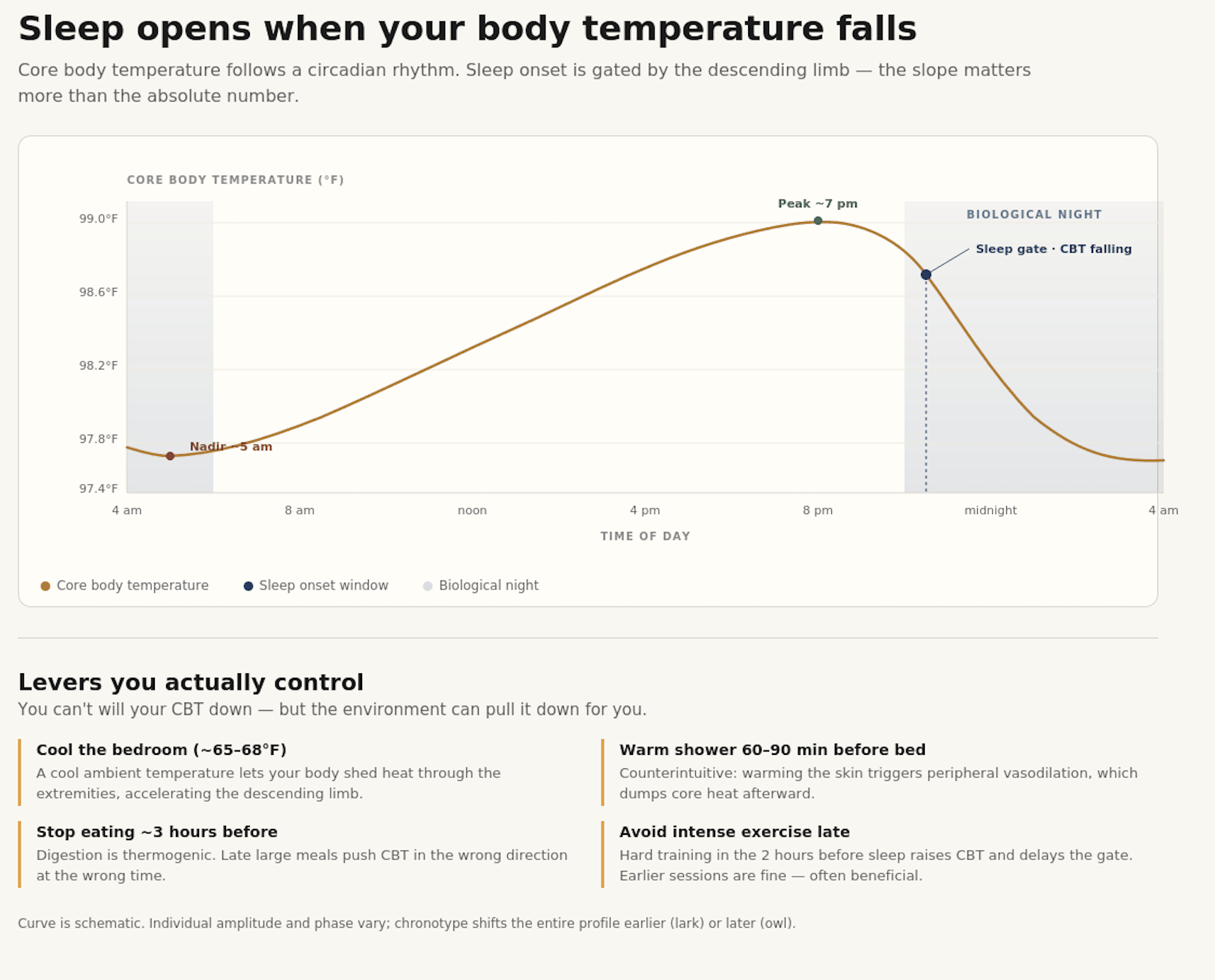
Thermoregulation is one of the more tractable levers for sleep architecture. Core body temperature must fall by about 1 to 1.5 degrees Celsius to initiate and maintain sleep. Cooling the sleep environment supports that drop, but the more interesting application is using this mechanism actively. Cold exposure in the late afternoon, a cold shower or brief cold water immersion, can accelerate the evening temperature drop and improve sleep onset without any supplementation required. If you already use cold exposure for recovery, timing it earlier in the day rather than right before bed tends to produce better sleep data.
Light timing affects circadian rhythm through melatonin suppression by the suprachiasmatic nucleus. Morning light exposure within 30 minutes of waking helps anchor the circadian clock and improves the timing of the evening melatonin rise. That matters because a well-timed circadian rhythm improves sleep architecture quality, not just total duration.
Caffeine cutoff
Caffeine is worth quantifying rather than managing by feel. The mean half-life is about 5 to 6 hours, but CYP1A2 variants create meaningful individual variation. Fast metabolizers may clear it in 3 to 4 hours, while slow metabolizers may take 8 to 10 hours. If you have run a genetic panel, your CYP1A2 status is worth knowing.
A practical default for most people is a 10-hour cutoff before target sleep time. Two hundred milligrams at 2 PM can leave roughly 50 mg active at 11 PM. That is enough to reduce slow-wave sleep depth measurably even when it does not delay sleep onset. Most people do not notice this subjectively, which is exactly why it belongs in a tracked protocol.
Alcohol
Alcohol is often misunderstood in recovery conversations. It is GABAergic and produces sedation, which is why it feels like it helps with sleep. The problem is that it suppresses REM sleep in the first half of the night, fragments sleep architecture in the second half as it metabolizes, and reduces HRV acutely.
Even moderate intake, two or fewer standard drinks, can produce measurable HRV suppression the following morning in wearable data. If you are running a recovery-focused protocol, the cost of alcohol is usually visible in the numbers.
Late training
High-intensity exercise elevates core temperature, cortisol, and adrenaline, all of which need time to clear before sleep. Training within two to three hours of bed tends to delay sleep onset and reduce slow-wave percentage in people who are sensitive to it. Zone 2 cardio appears to have less impact than intervals or heavy strength work.
If your schedule forces late training, the cooling strategies above become more important, not optional.
Supplements for Better Sleep That Actually Have a Mechanism
Once behavioral and environmental variables are addressed, specific compounds can support sleep quality. These are not substitutes for fixing the basics. They work within the same physiological systems and tend to produce more consistent results when the foundation is already solid.
Magnesium
Magnesium is a cofactor for GABA receptor function and plays a role in temperature regulation. Deficiency is common in people training regularly because sweat losses accelerate depletion, and dietary intake is often insufficient in modern food systems.
For sleep, the most relevant forms are glycinate, which is well tolerated with good bioavailability and minimal laxative effect, and threonate, which crosses the blood-brain barrier more effectively via a specific transporter mechanism and has preliminary evidence for sleep support. Doses in the range of 200 to 400 mg elemental magnesium taken 30 to 60 minutes before bed are the standard range in the research. Oxide is absorbed poorly and is not the form to use for sleep or recovery.
See the magnesium forms and dosing guide for a breakdown of which form fits your goals.
Glycine
Glycine is an inhibitory neurotransmitter that also promotes peripheral vasodilation, which helps lower core body temperature and supports sleep onset through the thermoregulatory mechanism above. A 2012 study in Sleep and Biological Rhythms found that 3 grams of glycine before bed improved subjective sleep quality and next-day cognitive performance compared to placebo.
The dose is practical and well tolerated. Glycine taken 30 to 45 minutes before sleep stacks cleanly with magnesium without producing sedation.
L-theanine
L-Theanine increases alpha-wave activity, which is associated with relaxed wakefulness and an easier transition into sleep. At 200 mg, it does not usually cause sedation on its own, but it can reduce the cognitive activation that keeps some people wired at night.
It is most useful when the barrier to sleep is a busy, active mind rather than physical restlessness. Some people take it about two hours before bed rather than right at bedtime, which can make the transition feel smoother.
Melatonin caution
Melatonin signals circadian timing rather than inducing sleep directly, and the dose question matters more than most people realize. The typical over-the-counter dose in the US is 3 to 10 mg, which is pharmacologically supraphysiological. Endogenous melatonin production is closer to 0.1 to 0.3 mg.
Research from MIT, including work by Richard Wurtman, has shown that 0.3 mg can be as effective as higher doses for improving sleep onset and circadian alignment, with a cleaner receptor response. Whether chronic nightly use at any dose causes receptor downregulation in humans is genuinely debated, and the evidence is less settled than people often claim. The more defensible use case is circadian correction, jet lag, shift work, schedule shifts, rather than nightly maintenance.
Why Tracking Changes the Decisions
Most advice on supplements for better sleep falls apart at the same point: recommendations are applied universally without any feedback mechanism. Whether glycine improves your deep sleep percentage, whether late training is affecting your HRV the next morning, whether the magnesium form you chose is doing anything measurable, none of that is answerable from population-level data. It requires your data.
A few variables are worth tracking.
HRV and resting heart rate trends
Single-point readings are noisy. A 7-day rolling average is more informative. A downward HRV trend across a training block is a signal to reduce load or add a recovery day, not to push through.
Oura and Garmin tend to produce more consistent HRV data than Apple Watch for this purpose, though all consumer devices have limitations, especially for sleep staging. Treat sleep staging from wearables as directional rather than precise. Trends matter more than absolute numbers.
Cortisol and testosterone
Morning serum cortisol and total testosterone give you a view into whether sleep quality is actually supporting hormonal recovery. Consistently high morning cortisol alongside low-normal testosterone is a pattern worth investigating further. DHEA-S and free testosterone add context.
These do not need to be drawn frequently. Quarterly labs during an active training block are usually enough to see meaningful trends.
Ferritin
Low ferritin is an underappreciated contributor to poor sleep quality and restless legs. It often shows up before anemia does and is commonly missed because it is not always included in standard panels. If you are training hard and sleep quality is poor despite solid habits, ferritin is worth checking.
Subjective check-ins
Wearables capture objective signals but miss subjective recovery. A structured morning check-in rating energy, mood, motivation, and soreness on a consistent scale gives you a dataset you can compare against objective metrics.
When HRV says you recovered well but subjective energy is low, that divergence is worth investigating. When they align consistently, your protocol is doing what you think it is doing.
Micros Tracker is built for this kind of cross-variable pattern detection. You can log your supplement stack, sync Apple Health data including sleep metrics, and add qualitative check-ins in the same place, so you can see whether a change like adding glycine or shifting your caffeine cutoff actually moved your recovery scores instead of assuming it did.
A 14-Day Experiment You Can Actually Run
Controlled experiments are how you generate usable data from your own biology. Here is a structured approach.
Days 1 to 3: Baseline
Log everything as usual. Record sleep duration, HRV, resting heart rate, and a morning subjective score for energy and soreness. Do not change anything. Establish what your current numbers actually look like before intervening.
Days 4 to 14: Intervention
Apply the following changes consistently:
Caffeine cutoff at 10 hours before target sleep time
No alcohol
200 to 400 mg magnesium glycinate and 3 grams glycine taken 30 to 45 minutes before bed
Consistent sleep and wake times within 30 minutes, including weekends
Room temperature set to support cooling
Avoid hard training within 2 to 3 hours of bedtime when possible
Log the same variables every morning. Note training sessions and intensity so you can separate training load from sleep effects.
At day 14, review the trends. Did your 7-day HRV average move? Did resting heart rate drop? Did subjective energy improve and stabilize? If multiple variables shifted in the same direction, you have evidence that sleep quality was a bottleneck in recovery. If one variable improved but others did not, that tells you something specific about which input was limiting.
A null result from a well-run experiment is still data. If the protocol did not move the markers, the bottleneck may be elsewhere, training volume, nutrition, iron status, vitamin D, or something worth investigating with labs. That is still useful because it narrows the search space.
The goal is not to confirm that sleep matters in general. Everyone already knows it does. The goal is to know whether improving your sleep, using these specific inputs, changes your specific recovery markers. That is a better question, and it only gets answered by tracking.
If you want to run this experiment with your supplement stack, sleep data, and check-ins in one place, try Micros Tracker or the web app.
What to Change First
If you want the blunt version, start here:
Fix sleep timing before adding more supplements.
Cut caffeine earlier than feels necessary.
Remove alcohol from the experiment if recovery matters.
Keep late training from bleeding into bedtime when you can.
Use magnesium, glycine, or theanine as tools, then track whether they actually move the numbers.
Sleep is the first recovery lever because it changes everything downstream. The only real question is whether your current protocol is helping or just looking good on paper.